A bridge that carries water
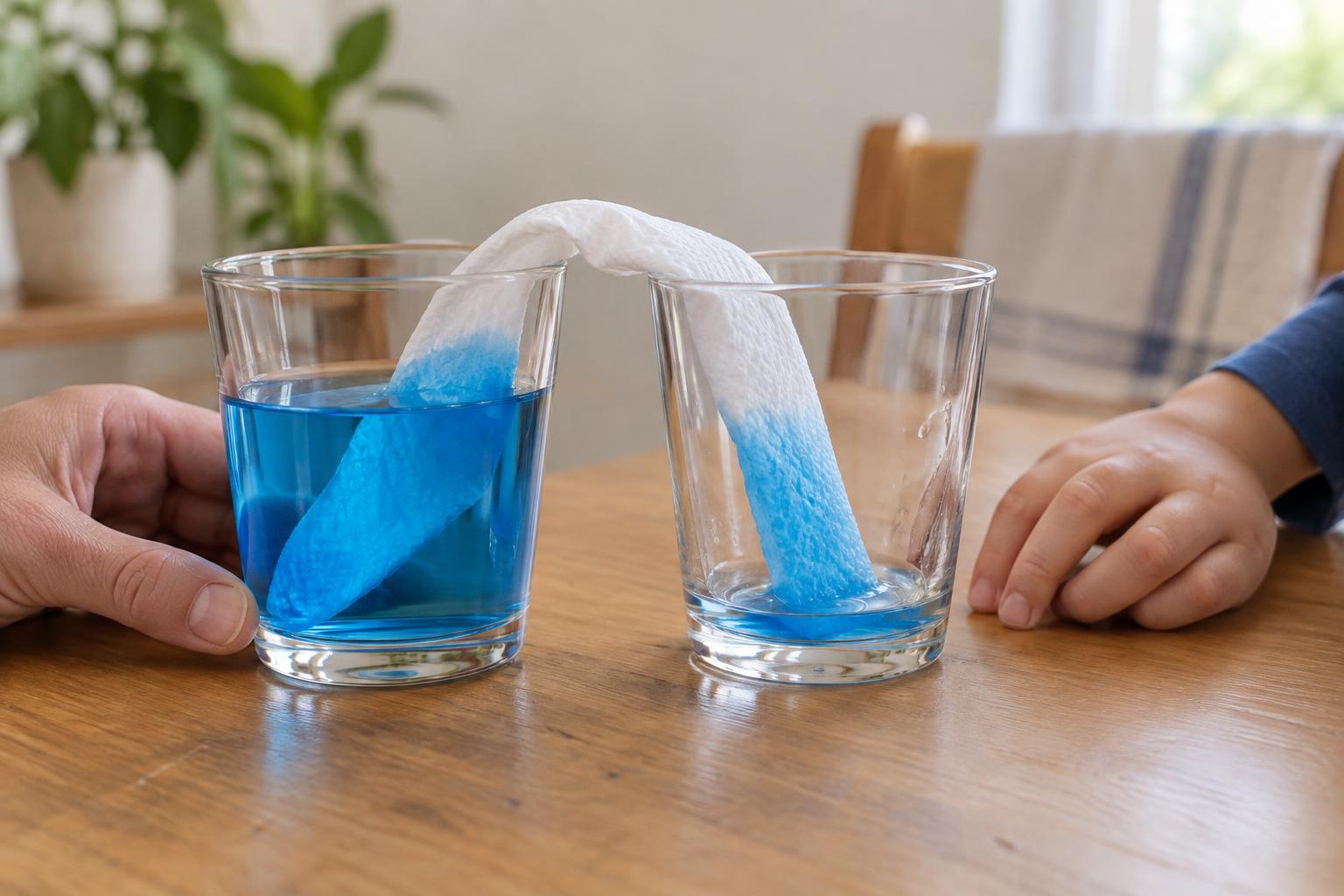
A paper towel can carry water without being poured or squeezed. With one end resting in a cup of water and the other in an empty cup, a folded strip gives water a path to follow. The change is gradual enough that children can draw what they see, make predictions, and return later to check them.
This activity works well when the goal is to observe before explaining. Ask, “Where do you think the water will be after ten minutes?” Then let the cups provide a surprise—or a reason to revise the prediction. A small amount of food coloring can make the water’s progress easier to see, but plain water works too.
Set up the investigation
Gather two clear cups of similar height, water, a paper towel, and a tray or washable surface. Food coloring is optional. Fold a paper towel lengthwise into a narrow strip long enough to reach the bottom of each cup while arching over the rims. Put the cups next to each other, fill one about halfway with water, and leave the other empty. If using coloring, add a drop to the water and stir.
Place one end of the strip in the water and the other in the empty cup. Make sure both ends touch the bottoms of their cups; a short strip may stop at the rim instead of delivering water. Leave the setup somewhere it will not be bumped. Coloring can stain, so protect the surface and have an adult handle it with younger children. Keep the cups for investigating, not drinking.
Look closely at the strip just after placing it. Is there a visible boundary between wet and dry paper? Check again after a few minutes, then at longer intervals. Children can mark the water levels on the outsides of the cups with removable tape or draw the cups in a notebook. They do not need exact measurements to notice that the starting cup has less water and the other may begin to collect some.
What makes the water move?
A paper towel is full of tiny spaces between its fibers. Water can cling to those fibers and move through the spaces, a process called capillary action. It can travel along the strip and rise above the water level in the first cup. Once the wet strip reaches the second cup, gravity helps water move down into it.
The result depends on the paper, how far the water must travel, and how well each end touches the water or cup. Water may move slowly, and the two cups may not end with exactly equal amounts: the towel holds some water, and some can evaporate. If nothing appears in the second cup, check whether the strip is long enough and whether its first end is still submerged before deciding the idea did not work.
Change one thing and compare
After watching the first bridge, try a second setup with a different paper, such as a coffee filter. Use the same cup size, starting water level, distance between cups, and observation times. Fold each material into a strip of roughly the same width and length. Ask which strip shows a wet edge first and which delivers visible water to the empty cup first. A material that soaks up water readily will not necessarily deliver it fastest, so record what happens rather than assuming the two observations mean the same thing.
For a simpler comparison, use two paper towel bridges of the same kind but place one pair of cups slightly farther apart. Keep both ends in contact with the cup bottoms and change only the distance. If a bridge needs a taller arch to span the gap, that may also affect the result. Noticing that complication is part of learning how to design a fair test.
Keep the question going
Invite children to finish with three notes: something they observed, something they think explains it, and a question they would like to test. “The paper turned blue” is an observation; “the water moved through tiny spaces” is an explanation. Keeping them separate makes room for new evidence, even when the activity does not turn out as expected.
For a change of setting after this tabletop experiment, browse Outdoor Activities · Everyday Playbook for ideas that take observation outdoors. If everyone would rather keep playing inside, explore Indoor Games · Everyday Playbook for another at-home activity.