Start with a few simple supplies
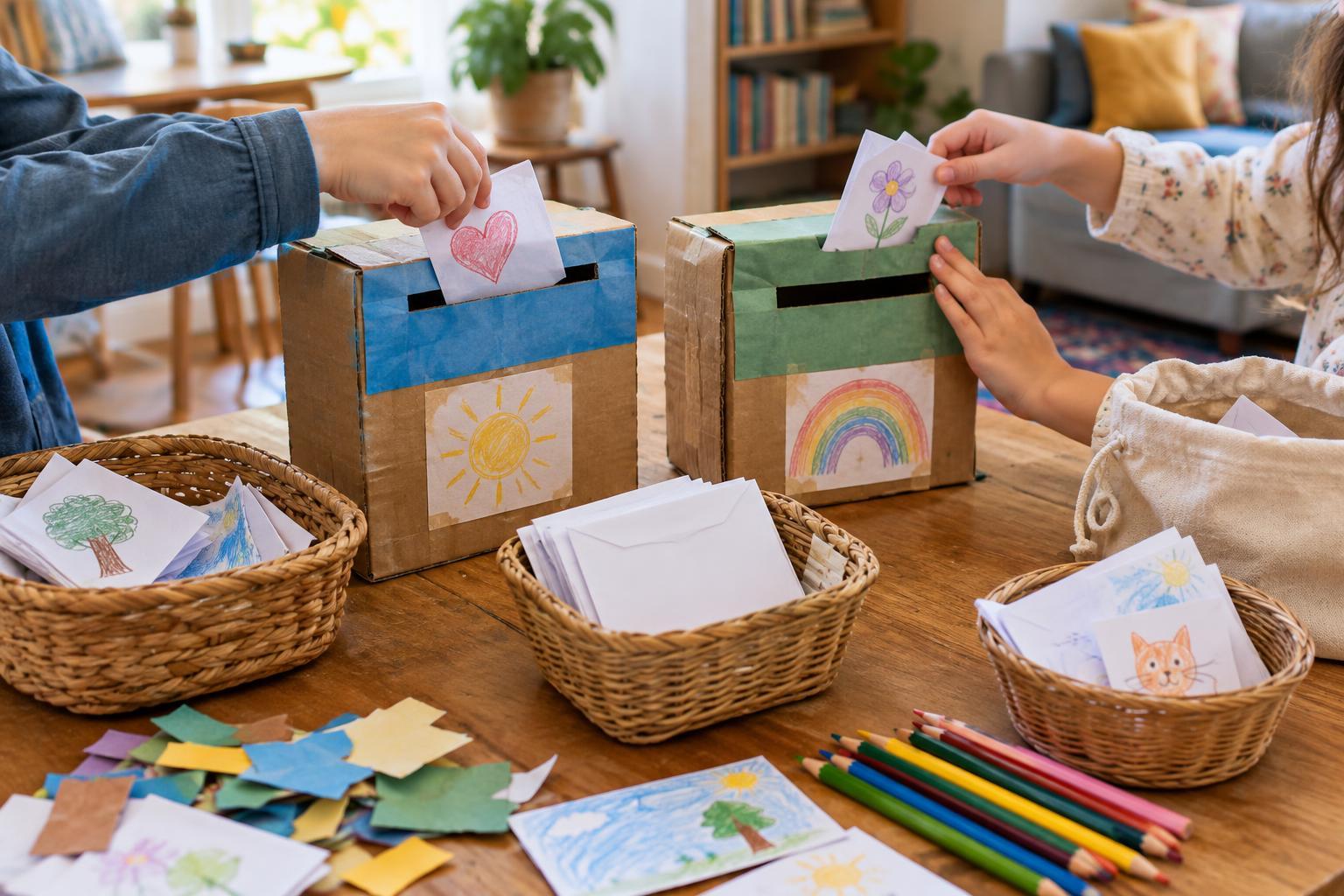
A pretend post office can begin with three things: something to send, something to carry it in, and somewhere to deliver it. Fold scrap paper into notes, use a small bag as a mail carrier’s pouch, and place a box or bowl at each delivery spot. There is no need to make everything look realistic. A container labeled with a drawing of a cat can be a mailbox for an imaginary cat.
Set out pencils or crayons, paper, and a few reusable containers, then invite children to decide what else the post office needs. They might make stamps from paper squares, draw signs, or build a counter from a sturdy box. Keep scissors and other tools suited to the children using them, and check small objects before offering them to younger children.
If preparing the activity starts to feel like a project for the adult, stop early. An unfinished setup gives children room to invent. A question such as “Where should our mail go?” is often a more useful starting point than a fully planned game.
Let messages take many forms
Not every piece of mail needs words. Children can send drawings, a pattern of shapes, a folded paper surprise, or a picture clue about where to find an imaginary treasure. A child who wants to dictate a message can ask an adult to write it down; another may prefer to make marks and explain what they mean. Both approaches belong in the game.
Invite children to invent recipients rather than using real names or addresses. A letter might go to a cloud, a toy animal, or the person who runs the make-believe moon café. Ask what the recipient might be doing when the mail arrives. That small question can turn a delivery into a story, without asking the child to produce a polished drawing or a correctly written note.
Adults can join by sending a short, playful message: “Dear Dragon, do you have room for one more guest at dinner?” Then leave space for any response, including no response. Children may be more interested in carrying and sorting mail than answering it. The delivery is part of the play, too.
Invent a delivery system together
Once there is mail to deliver, let children decide how it travels. They could sort it by the pictures on the mailboxes, draw a route across the room, or announce each stop as they walk. One child might run the counter while another delivers; a child playing alone can switch roles whenever they like. Simple jobs offer structure without fixing how the story must unfold.
If the game stalls, introduce a gentle complication. Perhaps a letter has arrived for someone who has moved to an underwater castle, or two mailboxes have the same symbol. Ask, “What could the post office do?” rather than supplying the solution. Children might redraw the route, make a new sign, or invent a vehicle for special deliveries.
There is no need to insist on real postal rules. The point is to agree on rules that make sense within this particular game. If children change those rules halfway through, ask them to explain the new system to anyone joining in.
Keep the game easy to revisit
For a short play session, make just two mailboxes and a handful of messages. For a longer one, children can add destinations gradually: a bookshelf mountain, a sofa island, or a town made from blocks. They can also create a collection box for mail waiting to be delivered. Adding one new place at a time keeps the activity from becoming a large setup that is difficult to clear away.
When play ends, save only the pieces children want to use again. A small envelope or folder can hold favorite letters and signs; containers can return to their usual purposes. Next time, the post office can open in a completely different world.
A pretend post office works because its pieces are flexible. The same folded paper can be a letter, a ticket, or a secret map, depending on what the players decide. Letting children make those decisions keeps the focus on imagination rather than on finishing a particular craft.