Start with a question, not a prediction
A seed contains the beginnings of a plant and a small store of energy. That raises an interesting question: does it need light to start growing, or does light become important later? A two-pot test lets children look for an answer rather than taking one on trust. The goal is not to produce the tallest plant. It is to notice when sprouts appear and how they change over the following days.
Before planting, invite everyone to make a prediction. Will one pot sprout first? Will the shoots be the same color? Write down each idea so you can return to it later. Different predictions make the test more interesting, and none needs to be right for the experiment to be useful.
Set up two nearly identical pots
Gather two small pots with drainage holes, two saucers, potting mix, and several seeds of the same kind. Beans or peas are useful choices because their shoots are large enough to observe easily. Put the same amount of mix in each pot and plant the same number of seeds at the same depth, following the seed packet if you have one. Label the pots “light” and “dark,” then water them equally until the soil is evenly moist, not soggy.
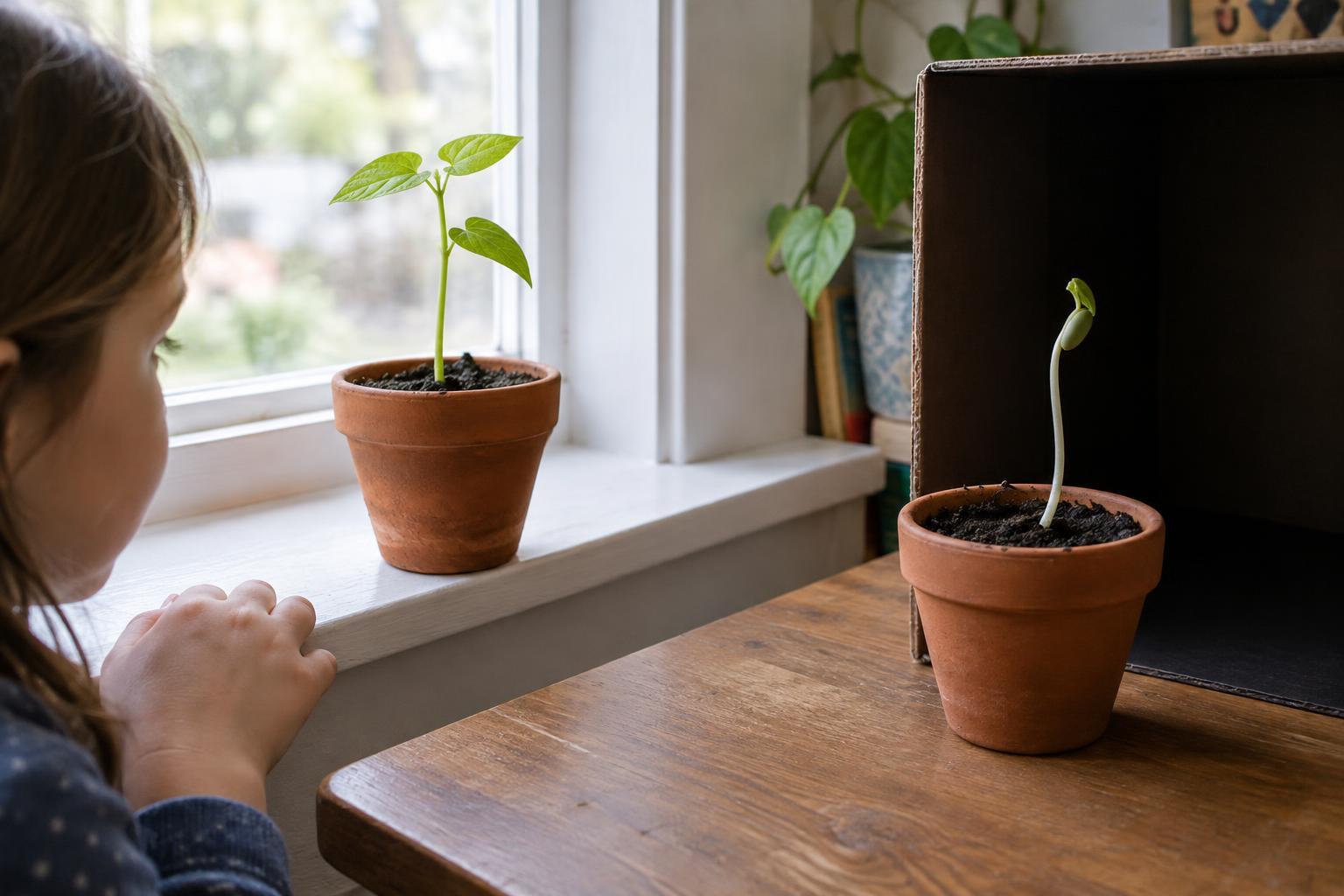
Place the light pot on a window sill that receives daylight without becoming excessively hot. Put the other pot in a dark, ventilated cupboard or a loose cardboard box nearby. Avoid a sealed container, and keep both pots where temperatures seem reasonably similar. A sunny window may be warmer and dry soil faster than a cupboard; those differences can affect the result. If the pots need water, add the same measured amount to each while keeping both soils similarly moist.
Observe without changing the test too much
Check the pots at about the same time each day. Briefly bring the dark pot into the light to observe it, then return it to its place. Record the day the first shoot appears in each pot. Once shoots are visible, note their height, color, leaf size, and whether they stand upright or lean. A ruler can help, but a drawing beside each day’s notes is just as valuable for spotting changes.
Young children might draw one sprout each day; older children could make a table with a row for each pot and a column for each observation. Encourage descriptions such as “pale stem with small leaves” rather than “unhealthy plant.” If no seeds sprout, check whether the soil dried out or became waterlogged. That outcome still provides a chance to think about what seeds need, though you may want to repeat the test.
Look beyond which sprout is tallest
Some seeds can germinate in darkness by using their stored energy. A dark-grown shoot may stretch and look taller than one by the window, yet have a pale stem and leaves that have not developed much green color. The light-grown shoot may be shorter but greener. Results vary with the seed, temperature, moisture, and amount of window light, so treat what you see as evidence from your setup rather than a rule for every plant.
Ask what “growth” means in your observations. Is it the first appearance of a shoot, an increase in height, or the development of green leaves? Those are related but different changes. A seedling can begin growing on stored energy, while light helps it make the food it needs as it continues to develop. This distinction explains why the tallest shoot is not necessarily the one doing best.
Change one thing for a follow-up
After several days of comparison, move the dark-grown pot into daylight and keep observing. Its new growth may become greener as it receives light. Rather than assuming an overnight transformation, record which parts change and how long you notice changes taking. Continue to keep the soil moist without leaving the pot standing in water.
For another round, try two pots in different daylight locations, such as a bright window and a spot farther into the room. Keep the seed type, pot size, soil, and watering routine as alike as you can. Each test gives your family practice with a useful science habit: change one condition, watch closely, and ask what else might explain the result.