Start with a question, not a definition
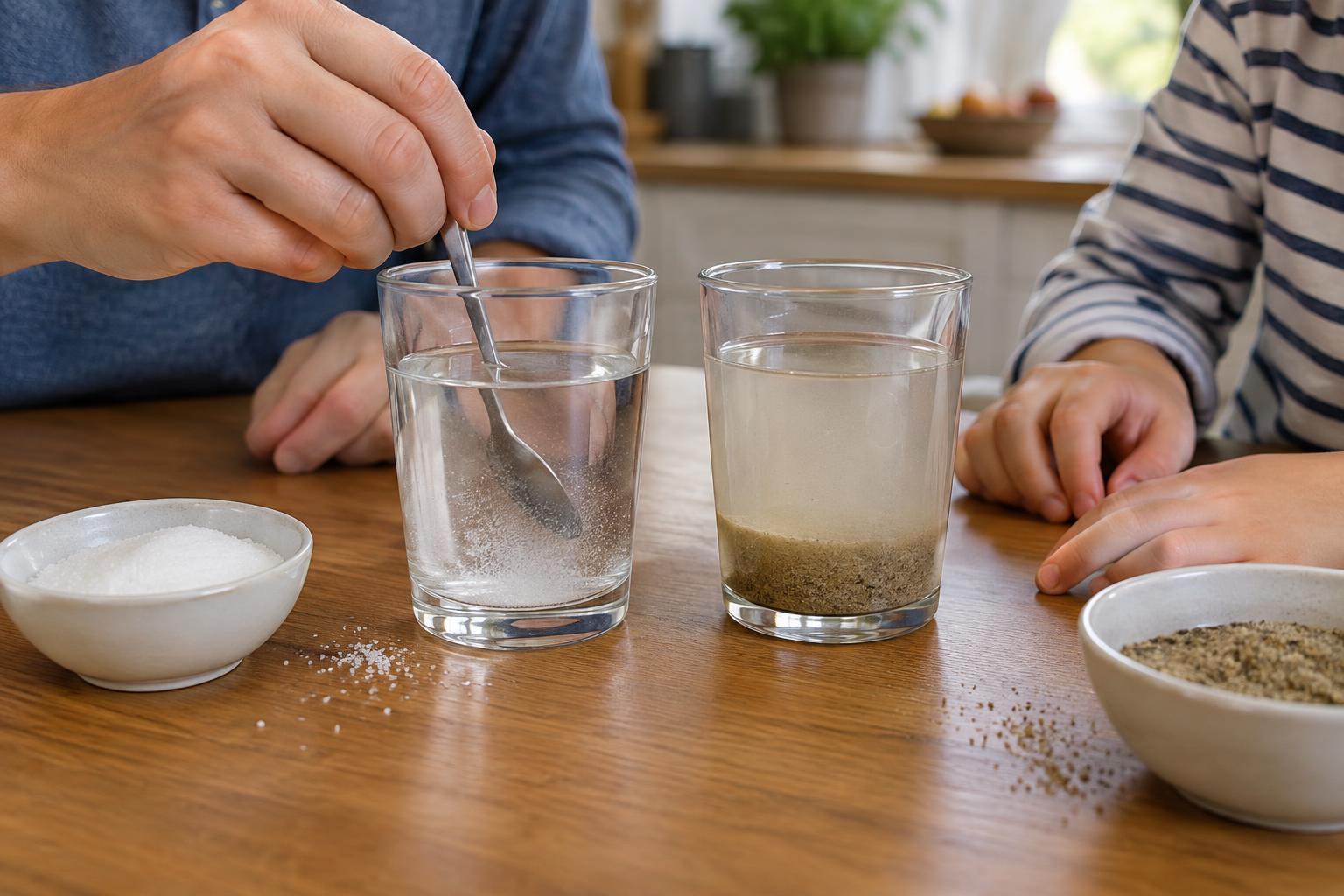
What happens when you stir something into water? Children may say that it disappears, melts, floats or makes the water cloudy. Each answer is a useful place to begin. Set out several clear cups of room-temperature water and small amounts of sugar, salt, clean sand, flour and cooking oil. Ask everyone to predict what each material will do before testing it. Use a separate spoon for each material so the results are easier to compare.
An adult can handle setup and cleanup, especially with younger children. Keep the materials out of mouths, use only small quantities and check for household sensitivities before choosing ingredients. Put the cups on a tray to catch spills. This activity works best when children can look closely, stir gently and change their minds about a prediction without worrying about getting it right.
Look for clues that something dissolved
Add a small spoonful of sugar to one cup and stir. At first, grains may be visible. After more stirring, the grains become difficult to see, although the sugar is still in the water. Salt usually behaves in a similar way when you use a small amount. We say these materials dissolve: their particles spread throughout the water rather than remaining as visible grains. The result is called a solution.
Ask children what evidence they can gather without tasting. Can they see grains on the bottom or along the sides? Does the liquid look the same from top to bottom? Leave the cup undisturbed for a few minutes and look again. Clear water alone is not proof that everything dissolved, but these observations give children a way to compare it with the other cups. If they add much more sugar or salt, some may remain on the bottom because the water can dissolve only so much under those conditions.
Compare materials that stay visible
Now stir sand into another cup. The grains may swirl while the spoon moves, then sink when the water becomes still. Sand and water are mixed, but the sand has not dissolved. Try flour in a different cup. It can make the water cloudy, form small clumps or settle slowly. Its behavior is not identical to sand’s, yet much of the flour remains as tiny pieces spread through the water rather than forming a clear solution.
Oil offers another contrast. Pour in a few drops and watch them gather near the surface. Stirring may break the oil into smaller droplets that move through the water for a while. After the cup rests, the droplets often join together again. Oil and water can be temporarily mixed by stirring, but ordinary cooking oil does not dissolve in water. Looking immediately after stirring and then again after a short wait makes this change easier to notice.
Make it a fair comparison
For a second round, invite children to design a more careful test. Give each cup the same amount of water, use roughly the same amount of each material and stir for the same number of turns. The aim is not laboratory precision. Keeping a few things consistent simply makes differences easier to spot. Children can draw each cup before stirring, just after stirring and after it has rested.
Try asking, “What changed when we stirred?” and “What happened when we stopped?” Those questions help separate the effect of stirring from the properties of the material. If children want to investigate further, they could compare a whole sugar cube with loose sugar, or test whether stirring for longer changes how quickly sugar dissolves. Change one thing at a time so the observation has a clearer meaning.
Keep the explanation simple and leave room to wonder
Mixing means putting materials together; dissolving is one possible result of mixing. A dissolved material has not ceased to exist, even when it is no longer visible as separate grains. Other materials may remain as pieces, create a cloudy mixture or separate into layers. These distinctions give children useful words for describing what they actually see, rather than asking them to memorize a rule before they explore.
At cleanup time, let sand and flour settle and place the solids in the trash rather than washing them down the drain. Wipe up small amounts of oil with a paper towel. Then revisit the original predictions: Which result was surprising? Which cup would they like to observe again tomorrow? The most valuable outcome is a habit of noticing that things can look very different after they meet water—and asking why.