Start with a question small enough to explore
Food history can begin with an ordinary question: Why does our family make this dish for a celebration? What did a nearby lunch counter serve? Where did people buy ingredients before the shops we know today? Pick one question rather than trying to describe an entire community’s cuisine. A narrow starting point gives children something concrete to investigate and leaves room for answers that may surprise them.
Make a page with two columns: “What we noticed” and “What we wonder.” A handwritten recipe might list an ingredient but not explain where it came from. An old menu might show a price but not reveal who could afford to eat there. Writing down those limits is part of the activity, not a failure to solve the puzzle.
Treat recipes and menus as clues
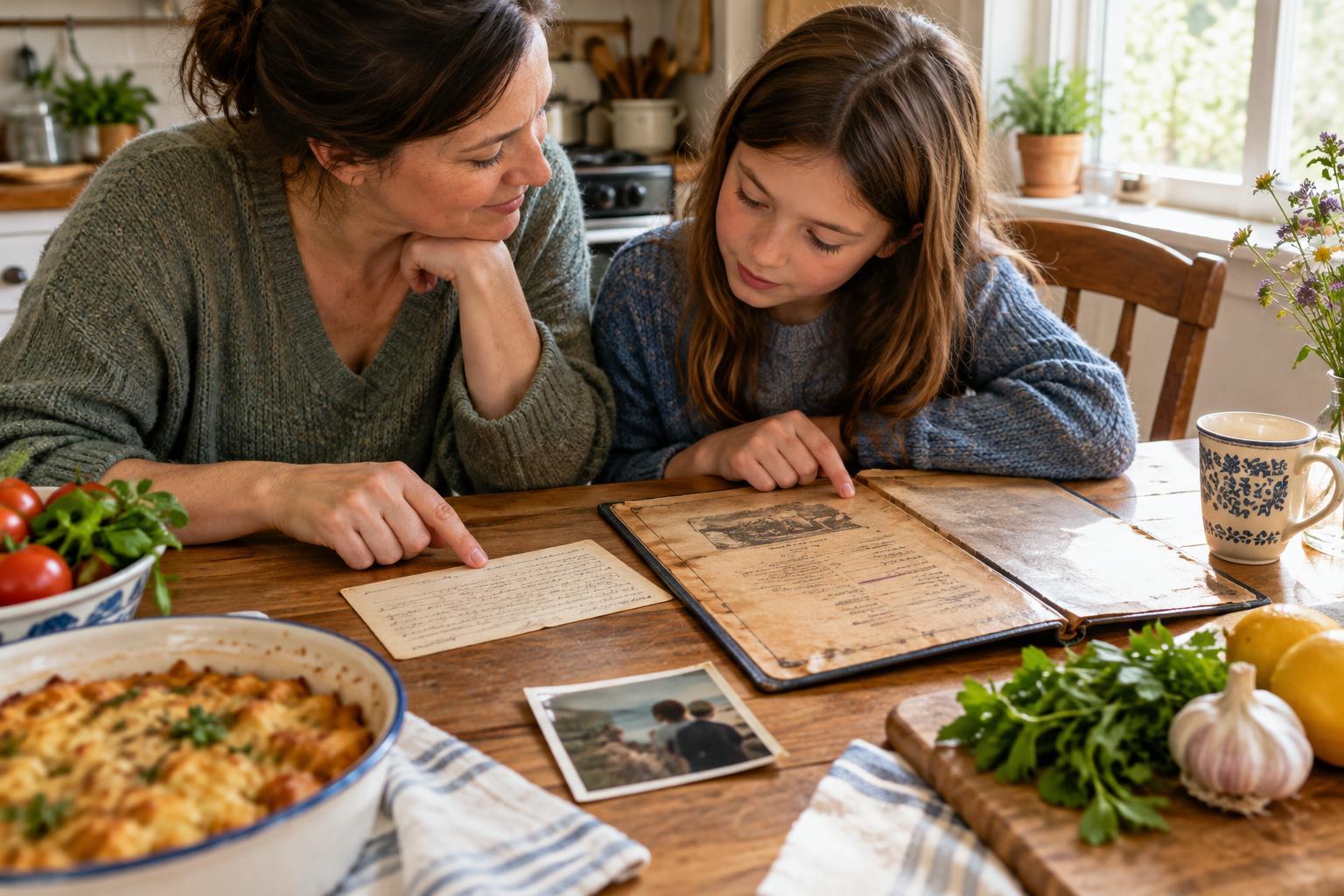
A recipe can show how one person recorded a dish at one point in time. Look for substitutions, serving notes, measurements, and signs of use, such as crossed-out quantities. Ask whether the cook learned it from someone, adapted it to available ingredients, or wrote it down for another person. If you can ask the cook, invite them to tell the story in their own words; do not fill in missing details on their behalf.
Menus, grocery advertisements, and community cookbooks offer different clues. A menu shows what an establishment offered, not necessarily what everyone in the neighborhood ate. An advertisement shows what a seller wanted customers to notice. A community cookbook may include several households’ contributions, but it does not represent every resident. Keep a note of where each item came from and, if known, when it was made.
Modern recipes can be enjoyable points of comparison without serving as evidence of a local past. For ideas to browse together, try Coastal Recipes · Citrus and Sea Kitchen and ask which ingredients you would need to find locally today. Then browse Sides and Salads · Citrus and Sea Kitchen to compare how different recipes combine familiar ingredients. These are prompts for conversation, not proof that a particular dish was once common in your neighborhood.
Ask about people without making assumptions
Food stories often connect to migration, work, celebrations, budgets, and access to ingredients. Those connections vary from household to household. Avoid deciding that a person cooked a dish because of their name, appearance, or background. Instead, ask open questions: “How did you learn to make this?” “Did you change anything?” “Was it an everyday meal or one for special occasions?” Give people the option not to answer.
If a relative or neighbor shares a memory, ask permission before recording or repeating it. Children can note the speaker’s own words, then distinguish that memory from a dated menu or recipe card. Two people may remember the same meal differently. Rather than choosing a winner, ask what each account helps you understand and what remains uncertain.
Try a tabletop food-history investigation
Gather two or three items you already have permission to examine: perhaps a family recipe, a photograph of a meal, or a menu saved from a local restaurant. Place them side by side. For each item, ask who made it, what it shows directly, and what it cannot tell you. Children can draw a magnifying glass beside a strong clue and a question mark beside an idea that needs checking.
Next, choose one modest follow-up. You might look for a dated version of a recipe, ask someone when they first remember making it, or compare menus from the same establishment if you have access to more than one. Keep your conclusion as precise as your evidence allows: “This menu offered the dish” is stronger than “Everyone here ate the dish.”
Share the story with its unanswered questions
Finish with a small display or notebook page titled with your original question. Include drawings or copies only when you have permission to use them. Label each item, add what you learned, and leave space for what you still do not know. If you cook a dish together, treat the cooking as a way to connect with the question—not as a reenactment that proves how people prepared it in the past.
The most useful result may be a better question. A single recipe can lead a family to wonder about a shop, a celebration, or a change in available ingredients. Following one clue carefully helps children see local history as something people investigate, revise, and share with care.