Start with a question you can test
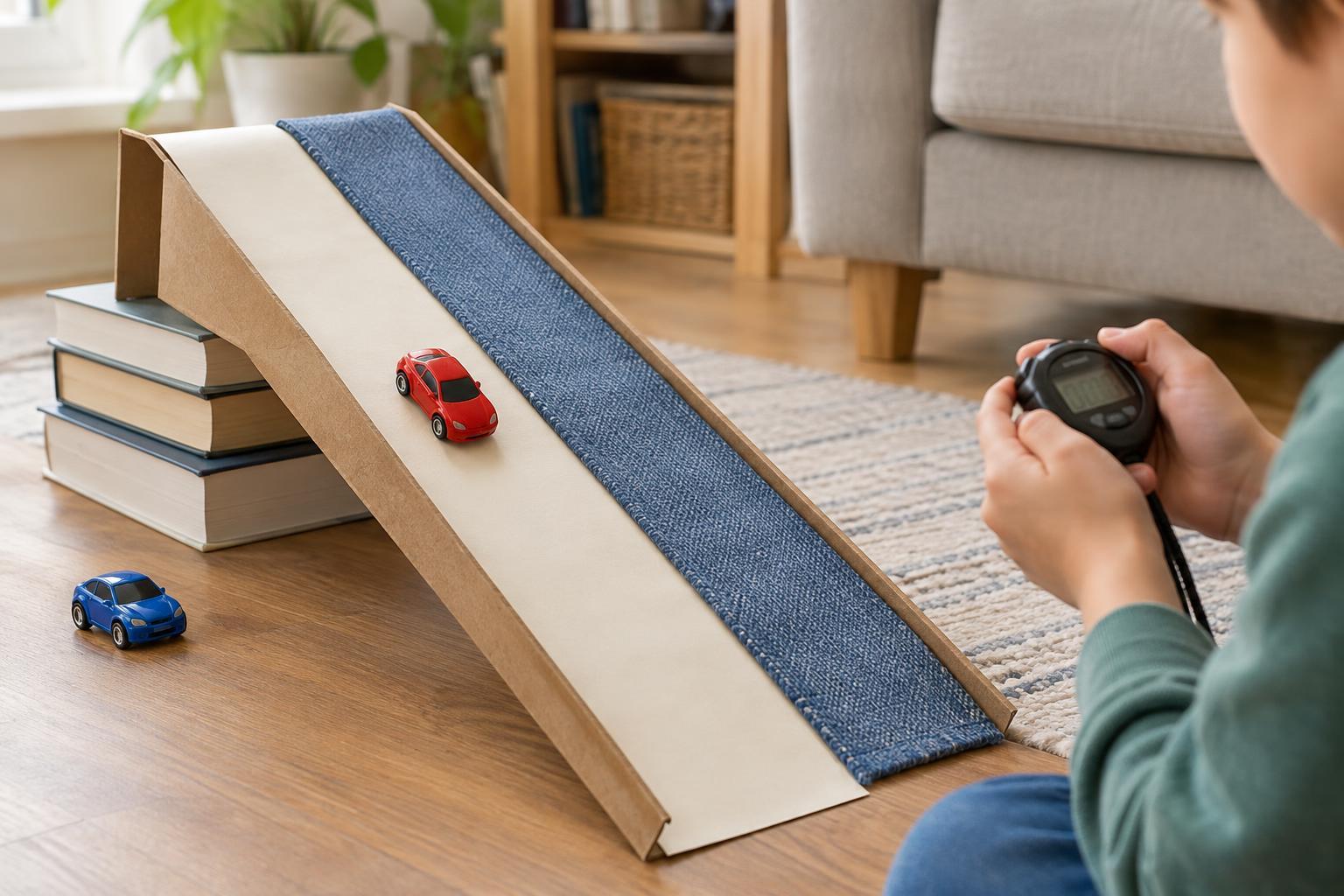
A toy car rolling down a ramp gives children something they can see, hear, and measure. Does it move just as quickly over a smooth sheet of paper as it does over a piece of fabric? Before testing, invite everyone to make a prediction. A child might expect the car to be slower on a bumpy surface, or wonder whether a soft surface will change how the wheels turn. The goal is not to guess correctly; it is to find out what happens.
For this activity, change the material covering the ramp while keeping the car and ramp setup the same. Time how long the car takes to travel between two marks. Short runs can be tricky to time precisely, so treat the results as comparisons rather than exact measurements of speed.
Build a steady ramp
You will need a toy car, a firm board or piece of cardboard, a sturdy stack of books, tape, a pencil, and a way to record results. Try a few surface materials you already have, such as printer paper, thin fabric, or a piece of felt. Each piece should be long enough to cover the section you plan to test. Use a phone timer or stopwatch if you have one.
Rest one end of the board on the books and leave the other end on the floor. Make sure it cannot wobble or slip. Mark a starting line near the top and a finish line farther down the ramp, with enough room for the car to roll before reaching the bottom. Tape the first material flat against the board, keeping tape out of the car’s path. Check that there are no loose edges to catch a wheel. Use the same car, book stack, and marked lines throughout the experiment. An adult can help steady the setup and keep the rolling path clear.
Run a fair test
Place the car at the starting line in the same position each time. Let it go without pushing. Start timing as its front reaches the starting line, and stop as it reaches the finish line. If two people are working together, one can release the car while the other watches the timer. Write down the surface and the time, then repeat the run a few times before changing materials.
Make a simple record with a row for each surface and spaces for each run. You do not need a perfect stopwatch technique to notice a clear pattern. If the times vary a lot, look for a possible reason: Did the car start crooked? Did the material bunch up? Did someone give it an accidental nudge? Straighten the setup and try again. For younger children, comparing which car arrives first during separate, carefully released runs can be more inviting than reading numbers.
Talk about what the wheels experienced
A rolling car interacts with the surface beneath its wheels. Friction is part of that interaction: it can resist motion where surfaces touch. On a soft material, wheels may also sink in slightly or meet small bumps, which can make rolling harder. A smooth, firm covering may let the car roll more freely. Your results might not follow a simple smooth-versus-rough order, because the material’s thickness, how tightly it is taped down, and the car’s wheels can all matter.
Ask children to describe what they observed before offering an explanation. Did the car slow suddenly at one spot? Did it rattle, roll quietly, or veer sideways? These details may point to a loose edge or uneven patch. If two surfaces give similar times, that is a useful result too. It may mean their effects are hard to tell apart with this setup, not that the experiment failed.
Try one new question
Once you have compared surfaces, choose one change for a follow-up test. Would raising the ramp make the difference easier to notice? Would a car with different wheels behave the same way? Make a new prediction, then change only that one feature while keeping the others as consistent as you can. If you raise the ramp, for example, test the same surfaces again with the same car.
Finish by asking each child to explain what they would tell someone who had not seen the experiment. They might say which surface produced the shortest times, describe an unexpected result, or suggest a better way to release the car. That conversation turns a familiar toy into a tool for observing, testing, and revising an idea.