Start with a sound you can see
Pluck a rubber band stretched across a box and listen. Then look closely: for a moment, the band seems to blur. It is moving back and forth too quickly for your eyes to follow clearly. That repeated motion is a vibration, and it is the starting point for this investigation.
The vibrating band pushes and pulls on the air around it. Those changes travel through the air to your ears, where you hear them as sound. The box may vibrate too, helping make the sound easier to hear. You do not need a perfect musical note to explore the idea. A twang, buzz or soft thump gives your family something to observe and compare.
Make a simple rubber-band instrument
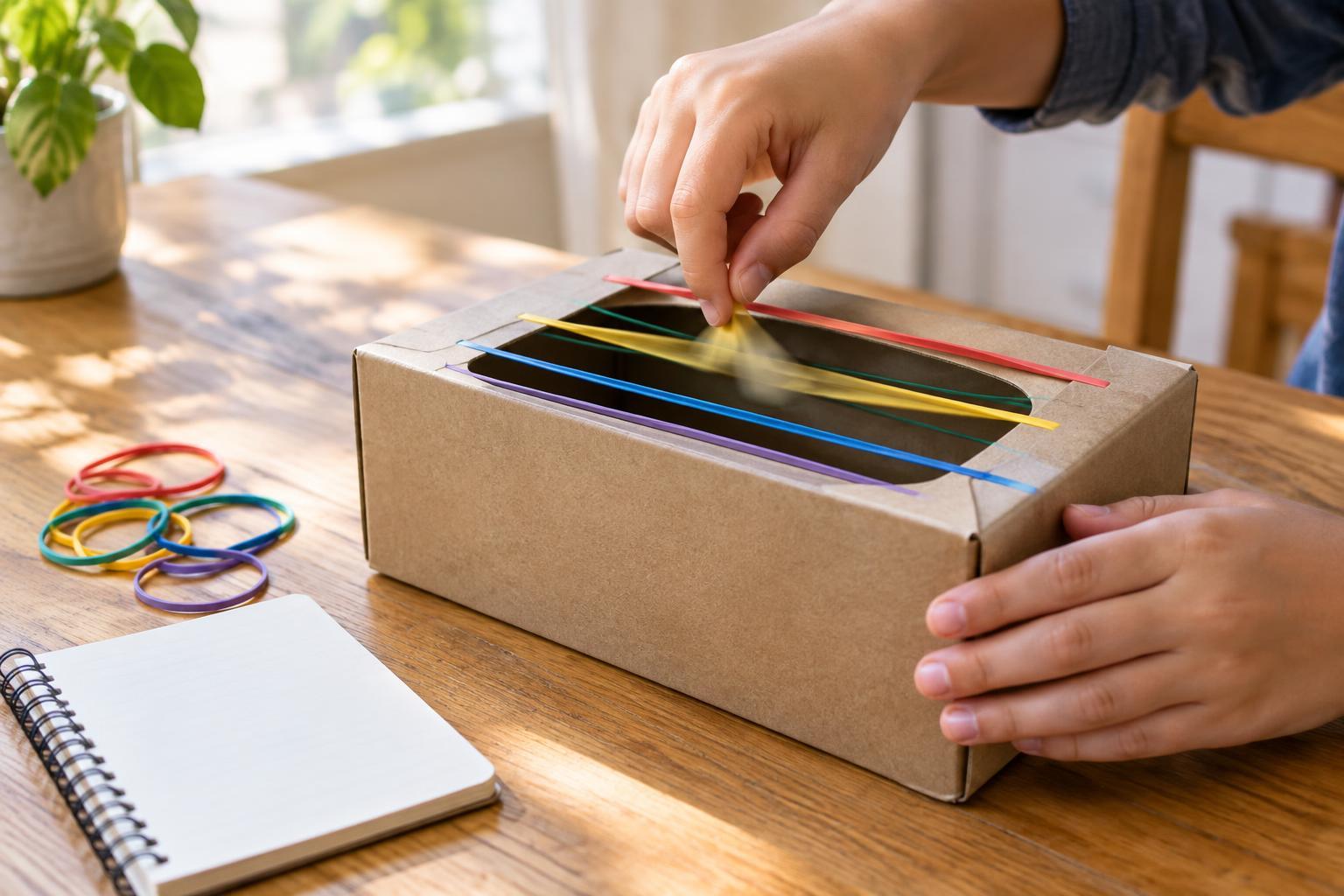
Gather an empty tissue box or small open-top cardboard box, several rubber bands of different widths, and a pencil and paper for notes. If you use a tissue box, remove any loose plastic film around its opening. Stretch one band around the box so that it crosses the opening and has room to move when plucked. Add other bands alongside it, leaving enough space to pluck each one separately. An adult can help younger children fit the bands.
Keep the bands at a comfortable stretch rather than pulling them as tight as possible. Check for cracks before use, and keep faces back while stretching and plucking in case a band slips or snaps. Put spare bands away from toddlers and pets. If a band is difficult to fit, choose a smaller box or a larger band instead of forcing it.
Invite your child to predict what will happen when they pluck a band gently, then more firmly. Does it sound louder? Can they spot the blur of the moving band? Try resting fingertips lightly on the box after a pluck to feel whether the cardboard moves. Let the sound fade before touching the band itself: stopping its vibration should stop the sound.
Change one thing at a time
Now turn the instrument into an experiment. Pick one band and pluck it near the same spot each time. First compare a gentle pluck with a stronger one. A stronger pluck usually makes a bigger vibration and a louder sound, but it does not necessarily make a higher note. Ask your child to describe what they hear before introducing words such as loudness and pitch.
Next, explore tension. With adult help, try the same band on boxes of slightly different sizes, or carefully reposition it so that it is stretched more or less. Avoid overstretching it. A tighter band often vibrates faster and produces a higher pitch. Changes to the box and the length of band that can move may also affect the result, so listen for patterns rather than expecting every setup to behave exactly alike.
Finally, compare bands of different widths on the same box. Do they sound alike? Because bands may differ in thickness, material and tension, width alone may not explain every difference. For a simple record, draw a row for each test and use words or symbols such as soft, loud, low and high. Notes help children compare what happened with what they expected.
Look for the vibration beyond the band
Sound can set other things moving, even when that movement is hard to see. Hold the box gently while someone else plucks a band, then set it on a table and listen again. The sound may change because the box and the surface beneath it can vibrate along with the band. Try the same band on an open-top box and a closed box, if you have both, and ask which sound is easier to hear.
These comparisons are not a contest to find the “best” instrument. They show that the sound you hear depends on more than the first thing you pluck. Encourage descriptions such as “short and buzzy” or “low and quiet.” Everyday language is a useful way to begin noticing differences; children can connect those observations to scientific terms as their questions grow.
Keep investigating with questions
If a result surprises you, repeat the test. Was the band plucked in the same place? Was the box being held or resting on the table? Did two bands touch? Adjusting one detail and trying again is part of investigating, not a sign that the first attempt failed.
End by inviting your child to design a short tune or sound effect with the bands. Which one makes the deepest sound? Which stops ringing soonest? The instrument may not stay in tune, and that is fine. It gives children a hands-on way to connect what they can see and feel—a moving band and sometimes a moving box—with what they hear.