Start with a question you can test
A fair test begins with a question about what might happen when one thing changes. Suppose your family wonders, “Does a toy car travel farther when it starts from a higher ramp?” That question gives you something to change and something to observe. It is more useful for an experiment than “Which ramp is best?” because everyone can agree on what to measure.
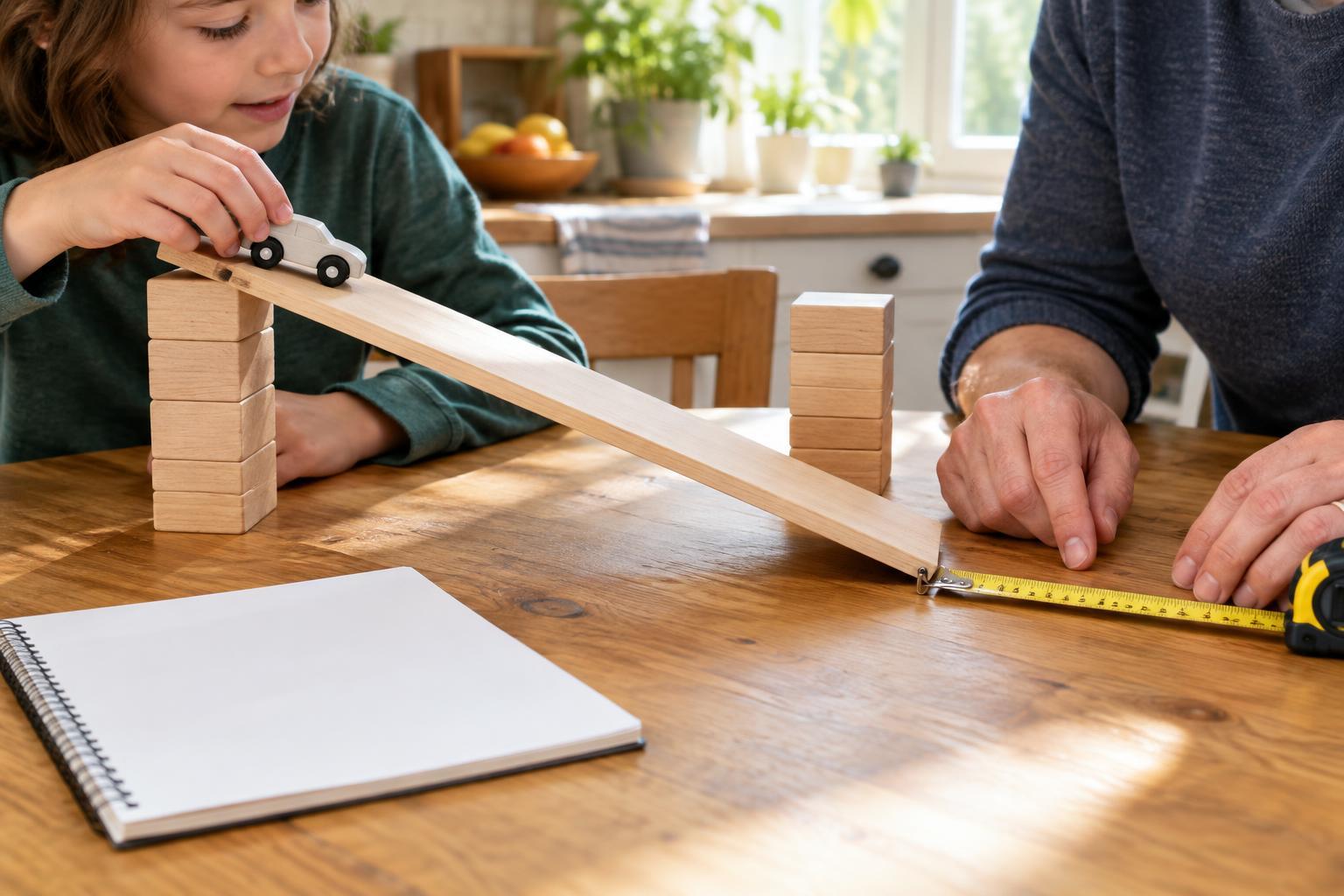
Gather a toy car, a sturdy board or large piece of cardboard for a ramp, a few books, masking tape, paper and a ruler or tape measure. Set up on a clear floor where the car can roll safely. Young children may enjoy making a prediction before the first run: higher, lower or about the same distance? A prediction is a starting idea, not an answer they need to get right.
Change the ramp height, not everything else
For this test, ramp height is the one thing you deliberately change. You might rest the top of the ramp on one book for the first set of runs and two books for the second. Keep the same car, ramp, floor and starting mark. Release the car without pushing it, and try to place it in the same direction each time. These steady conditions make it easier to connect any difference you see with the change in height.
A strip of tape can mark where the car starts, and another can mark the end of the ramp. Measure from the end of the ramp to where the car stops. If the car veers sideways or hits furniture, clear a wider path and try that run again. You do not need laboratory-perfect control; the goal is to notice which details could affect the result and make the test as consistent as you reasonably can.
Repeat each setup and record what happens
One roll can be misleading. A wheel may catch on a seam in the floor, or someone may accidentally give the car a nudge. Try at least three rolls at each height. Write down each stopping distance, or place a small piece of tape where the car stops and label it. For younger children, a drawing of short, medium and long rolls may be more inviting than a table of numbers.
Once you have several runs, look at them together. Did the car usually go farther from one height? Were the distances similar, or did they vary a lot? You can compare the groups without calculating anything complicated. If you do use numbers, choose one unit of measurement and stick with it. Recording the runs you did not expect is important, too: those results can help you spot an uneven surface or a change in how the car was released.
Talk about what the test can—and cannot—show
Ask, “What did we change? What did we measure? What did we try to keep the same?” Then invite children to describe the results in their own words. They might say, “Our car usually rolled farther from the taller ramp.” That is a useful conclusion about this car, this ramp and this setup. It does not mean every car on every surface will travel the same distance.
If the results are mixed, the investigation has not failed. Check whether the books shifted, the ramp bent or the release point moved. You can adjust the setup and test again. Resist changing the car and the ramp height together: if the next roll travels farther, you will not know which change mattered. A fair test helps narrow down a possible explanation, even when it does not give a tidy answer.
Try a new question with the same method
After testing height, return the ramp to one chosen height and ask a different question: does the car travel farther on a smooth floor or on a towel? Now the surface is the one thing you change. Keep the car, ramp height, starting point and release method as steady as possible. Or test two toy cars while keeping the ramp and floor the same. Treat each new question as its own experiment rather than adding changes to the first one.
The habit to carry into other activities is simple: name the change, decide what to observe, keep other conditions steady and repeat. Children can use it to compare how quickly ice melts in different spots or how far paper shapes glide when dropped from the same height. Everyday materials are enough to practice asking careful questions—and to discover that unexpected results are reasons to look more closely.