What a balance scale can show
A balance scale makes a comparison visible. Put one object on each side, and the heavier side usually moves down. If the sides stay nearly level, the objects may be close in weight. The scale does not need numbers to spark a useful question: Which object is heavier, and how can we tell?
This project works well with familiar items such as a small sponge, a toy car, a large wooden block or a folded washcloth. Ask children to predict what will happen before each test. An object that looks bigger is not always heavier, so their guesses may lead to interesting surprises.
Gather and build
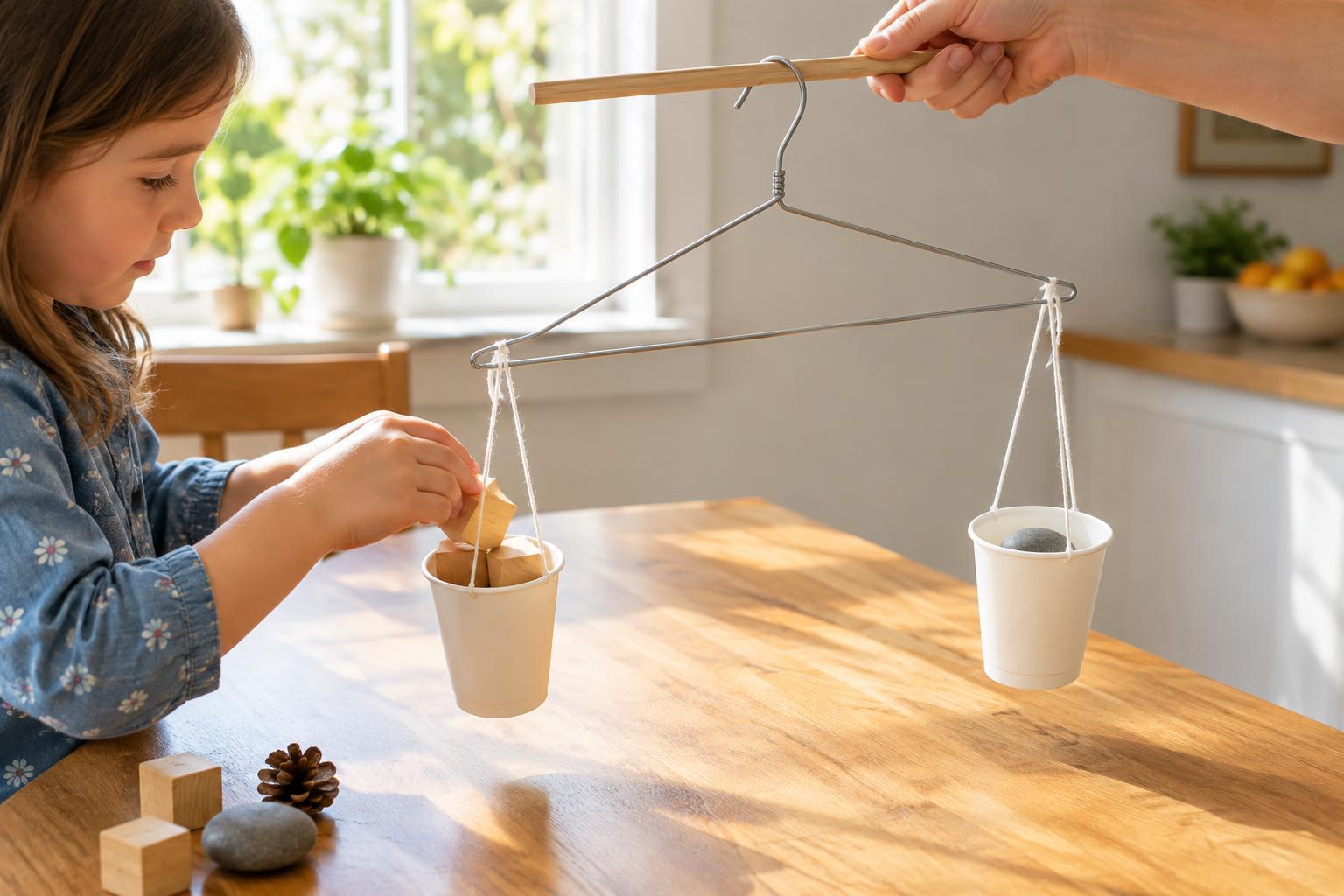
You will need a sturdy coat hanger, two matching paper cups, string, tape and a way to make holes near the cup rims. An adult can make two holes opposite each other in each cup. Thread a piece of string through each pair of holes and tie it into a handle. Make the handles roughly the same length so the cups hang at similar heights.
Tape one cup handle near each end of the hanger, placing them the same distance from the center hook. Hang the hook from an adult’s finger or a secure support over a table. Let the empty cups settle. If one side sits lower, check that the cups match and move a handle slightly until the hanger is approximately level. Keep the scale low so a falling object has little distance to drop.
Test, observe and try again
Choose two objects that fit comfortably inside the cups without stretching the handles. Place one object in each cup, then take your hands away and wait for the motion to stop. Which side ends up lower? Invite children to describe what they see before deciding what it means. If the hanger swings, waiting a few moments makes the result easier to read.
Swap the objects between cups and repeat the test. The same object should bring down the same side of the comparison even after it moves to the other cup. If it does not, look for a cup caught on the table, a sliding handle or an empty scale that was not level. Troubleshooting is part of the experiment: it helps children see that the way a tool is built affects what it shows.
Make comparisons fair
A balance works best when the cups hang at equal distances from the hook. Imagine two children on a seesaw: where they sit matters as well as how heavy they are. That is why moving a cup along the hanger can change the result. For a fair comparison, leave both cup positions fixed while testing different objects.
Try sorting several safe objects from lightest to heaviest. Compare two at a time, then test neighboring objects again if the order is unclear. Children can draw the objects in their predicted order and revise the drawing after testing. When the cups appear nearly level, it is fine to say the scale cannot show a clear difference. This homemade tool is useful for comparing, not for finding an exact weight.
Extend the investigation safely
For another challenge, put one larger object in a cup and add identical large blocks to the other cup one at a time. How many does it take to bring the cups close to level? Use blocks that are alike; blocks of different sizes or materials may not contribute the same weight. Children can record their results with drawings or tally marks, then compare what happened with their predictions.
Use only light, unbreakable objects that fit securely in the cups. Avoid glass, liquids, sharp items and small pieces that could be a choking hazard for younger children. An adult should handle the hole-making and help keep the hanger steady. When the experiment is finished, ask which result was most surprising and what the family would change if they built the scale again.