Make room for every kind of movement
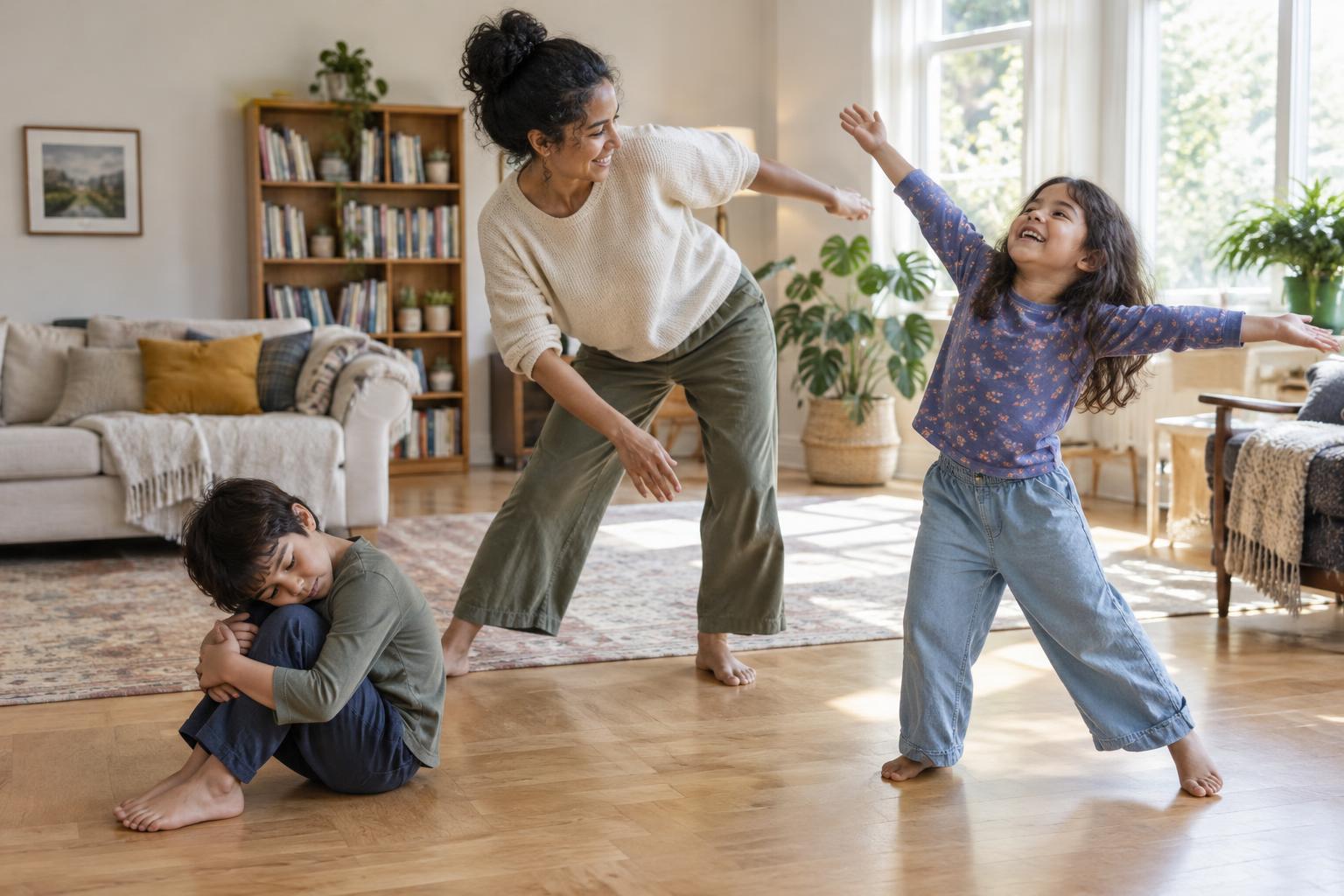
Dancing about feelings does not mean acting out a perfect version of “happy” or “angry.” One person’s excitement might look like quick hops; another’s might be a shoulder lift or a finger tapping on a table. Start by telling everyone that small movements, seated movements and watching are all welcome. The goal is to experiment, not to guess what someone feels inside.
Clear a little floor space, move breakable objects aside and choose a volume that lets people hear one another. Music is optional: claps, a gentle beat tapped on a knee or quiet can work just as well. Invite each player to choose whether others may copy their movements, and make it easy to pause at any point. A brief warm-up—rolling shoulders, reaching comfortably or wiggling fingers—helps everyone find a way in.
Play the feelings weather report
Ask, “If a feeling were weather, how might it move?” Offer an imaginary forecast such as a breezy morning, a slow drizzle or a burst of sunshine. Players make a movement to match: hands may drift like clouds, feet may patter like rain, or arms may open like sunlight. After a few moments, call out a new forecast and let the dance change.
There is no need to assign one emotion to each type of weather. A drizzle might feel peaceful to one person and gloomy to another. If children want to name a feeling, listen without correcting their choice. If they would rather talk about clouds and wind, keep playing. For a gentler version, have each person move only their hands while seated; for an energetic version, travel across the room while keeping a safe distance from others.
Try a mirror, then make a new shape
In pairs, one person leads a slow movement while the other mirrors it. Suggest prompts such as “Show a curious movement” or “Make a shape that feels calm.” A leader might lean to one side, stretch a hand upward or curl inward. After about half a minute, switch roles. Slow movements give both partners time to notice and respond, and nobody has to explain a personal feeling.
Next, invite each pair to create a third movement together. They might combine a reaching arm with a careful step or turn two separate gestures into one shared rhythm. Ask what they noticed about working together: Was it easier to lead, follow or invent? These questions keep the focus on choices and collaboration rather than judging anyone’s dance.
Build a dance with “and then”
This game turns changing feelings into a short movement story. Begin with a simple prompt: “A character is waiting for a friend.” Someone chooses a movement for the first moment, perhaps tapping a foot. The next player adds an “and then”: the character hears a sound and looks around with a turn of the head. Keep adding moments until the group has a sequence of three or four movements.
Try the sequence again and change one detail. What if the friend arrives? What if the character spots a butterfly instead? The same foot tap might lead to a delighted spin, a cautious step or a quiet wave. Children can invent fictional characters if talking about their own experiences feels too personal. A short sequence is enough; repeating it can be more fun than making it longer.
Finish with a choice, not a performance
At the end, invite everyone to pick a closing movement: shake out their hands, take one slow step, stretch or become still. Anyone who wants to can share a favorite movement from the games. Others may simply point to it, demonstrate it or pass. Avoid asking children to perform alone unless they volunteer.
You can return to these games with new prompts from everyday life: the anticipation of opening a library book, the surprise of finding a puddle or the comfort of coming home. Notice how the movements change from day to day without treating any dance as a test of someone’s mood. The useful question is not “Did we dance the feeling correctly?” but “What else could this movement become?”