Start with a sound hunt
Music can begin with a question: What sounds can we make right here? Invite everyone to pause and listen for a moment. You might notice footsteps, a humming appliance, or the soft tap of a finger on a table. Then explore sounds you can control. Try a whisper, a clap, or a gentle tap on an empty container. The goal is not to perform well; it is to notice how sounds differ.
Before the games begin, agree on a comfortable volume. A sound that delights one person may bother another, especially in a shared home. Let anyone request a quieter sound or a break. If you use objects, choose sturdy items without sharp edges or small loose pieces, and keep breakable belongings out of the music area. Hands and voices alone are enough if gathering materials feels like too much work.
Play with your voices
Try an echo game. One person makes a short sound, such as “la-la,” a hum, or a playful “whoosh.” Everyone else echoes it back. Begin with sounds that are easy to remember, then experiment with changes: high or low, long or short, quiet or a little louder. Take turns leading so each player gets to invent a sound. Anyone who would rather not vocalize can lead with a gesture for the group to copy.
For a story version, imagine a walk through an invented place. What might a creaky gate sound like? How about a gentle breeze or tiny footsteps? Each person contributes one sound to the scene. There is no need to imitate anything perfectly. The fun comes from hearing how different people picture the same idea, then arranging their sounds in an order that tells a story.
Build rhythms with claps and pauses
A rhythm can be as simple as clap, clap, rest. Make a pattern and repeat it a few times, leaving a clear pause where everyone stays still. Then ask someone to change just one part. They might add a clap, replace one clap with a knee pat, or make the pause longer. Repeating a pattern helps everyone hear what changed, while the pause makes silence part of the game.
To make a rhythm conversation, have one person offer a short pattern and another answer with a different one. An answer does not have to match. It might be slower, softer, or made with finger taps instead of claps. If keeping a shared beat is tricky, slow down until everyone can join comfortably. Players can also move, point, or listen rather than clap.
Invite household objects into the band
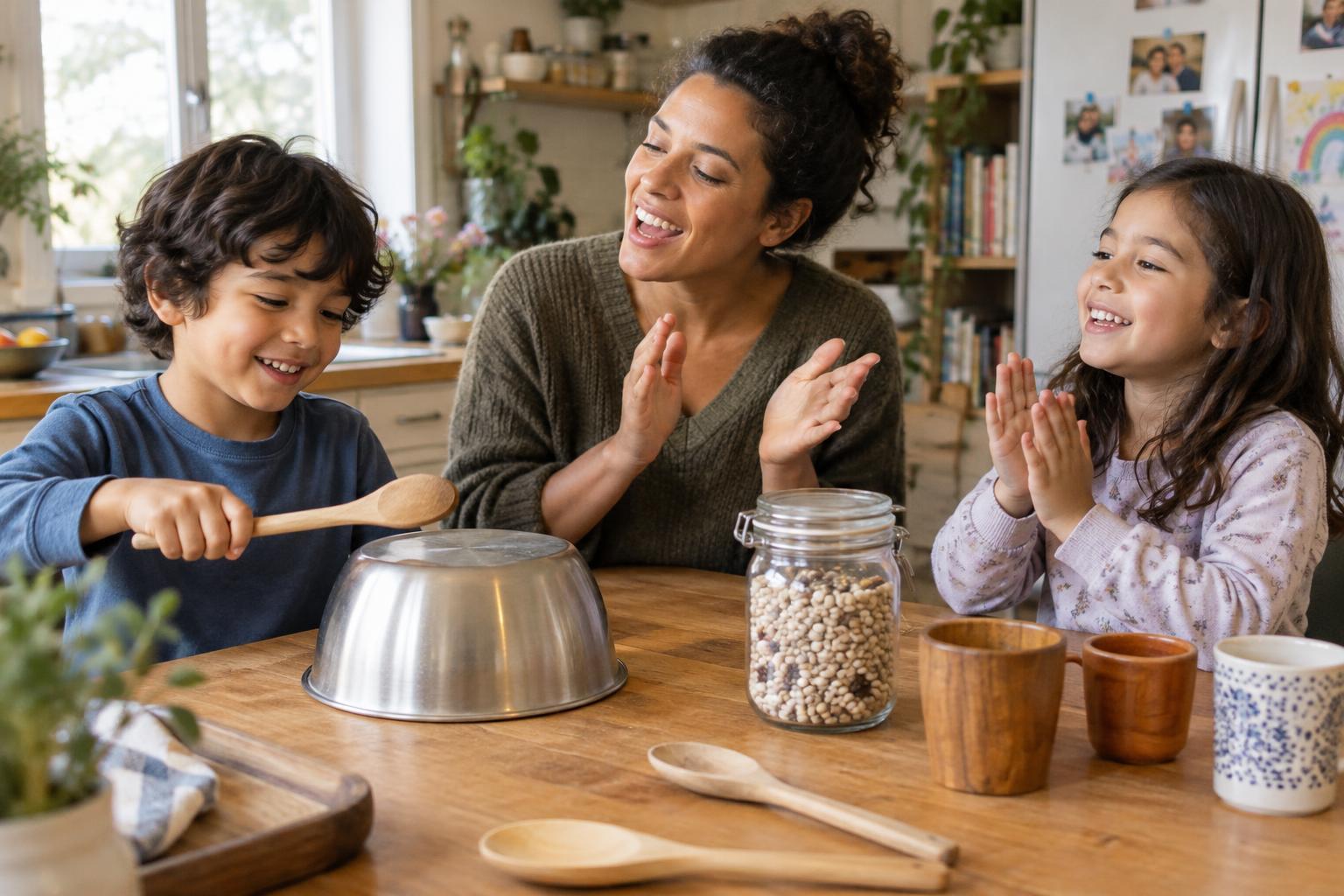
An empty cardboard box, a wooden spoon, or a sealed container can bring a new sound to the group. Explore one object at a time: Does a fingertip tap sound different from a gentle palm tap? What changes when you tap the center of a box instead of its edge? Compare sounds without deciding that one is better. This turns the activity into a small experiment as well as a game.
Once everyone has found a sound they like, give each sound a job. A soft tap could keep a steady beat, while a rustling piece of paper could appear only at the end of a phrase. A leader can signal when each player starts and stops. Keep taps gentle, and skip glass, heavy items, or anything that could spill or break. If an object makes an uncomfortable noise, trade it for a quieter one.
Put the sounds together
Choose three favorite sounds from your games and arrange them into a short piece. For example, begin with two whispered sounds, repeat a clapping pattern, and finish with one soft box tap. Practice it once, then let someone suggest a change. You could reverse the order, add a pause, or let one person make an unexpected ending. A piece does not need a name, but inventing one can be part of the play.
To remember your creation, draw a simple sound map. A hand shape can stand for a clap, a circle for a tap, and a blank space for a pause. Read the map from left to right as you play. Next time, you can try it again or rearrange the symbols into something new. The most useful result is not a polished song; it is the chance to listen closely, make choices together, and discover what ordinary sounds can do.