Start with one tree
A walk around the block can feel different when your family chooses one street tree to investigate. You do not need a field guide or a correct answer to the question “What kind is it?” Instead, ask what you can notice: Where does its trunk begin to branch? Is the bark smooth, ridged or patchy? Does its shade reach the sidewalk, a wall or both?
Pick a tree you can observe comfortably from a public sidewalk without blocking other people. Give everyone a quiet minute to look before sharing ideas. A young child might spot a root lifting the soil; an older child might notice that branches grow farther over the street than over a building. Both observations are useful. The aim is to practice looking, not to finish with a label.
Look from near, far and underneath
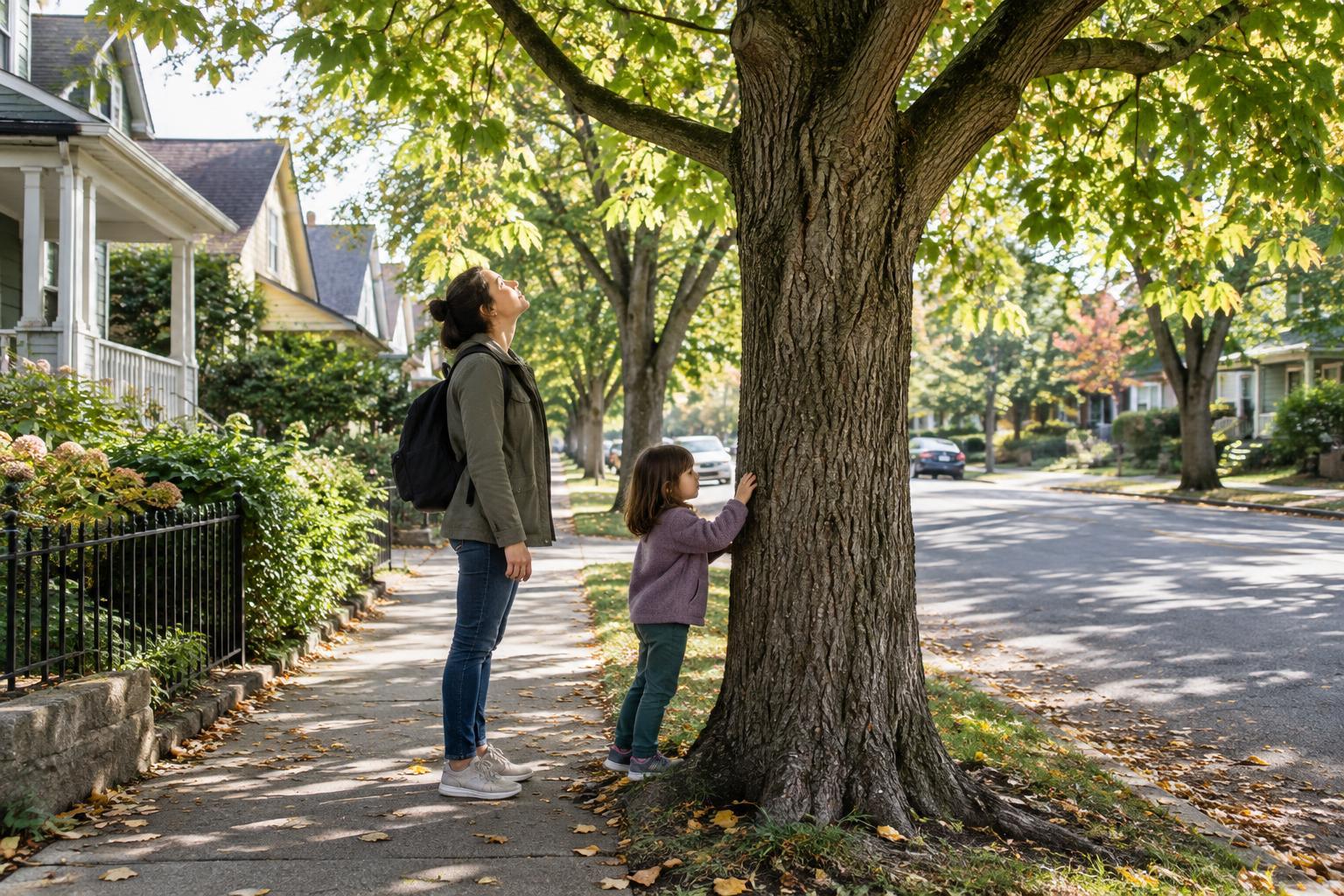
Begin a short distance away, where you can see the whole shape of the tree. Does it look round, narrow, lopsided or wide like an umbrella? Step closer and look at the trunk. You can describe the bark with comparisons: lines like roads on a map, plates like puzzle pieces or pale spots against a darker surface. If touching is permitted and safe, compare how the bark feels with how it looks.
Then look upward from a safe place beside the trunk. Notice the spaces between branches and the patches of sky they frame. Do the leaves overlap into one dense ceiling, or can you easily see through them? If a leaf or seed has already fallen onto the pavement, examine it without pulling anything from the tree. Its outline, edges and texture can prompt good questions even if you never identify it.
Try a small observation game
For a quick family challenge, choose two trees on the same block and look for three differences that do not depend on their names. One might have branches that begin high above your head, while another has low branches. Their bark, shadows or fallen leaves might differ. Invite each person to add one similarity, too. This keeps the game from becoming a contest to find the most unusual tree.
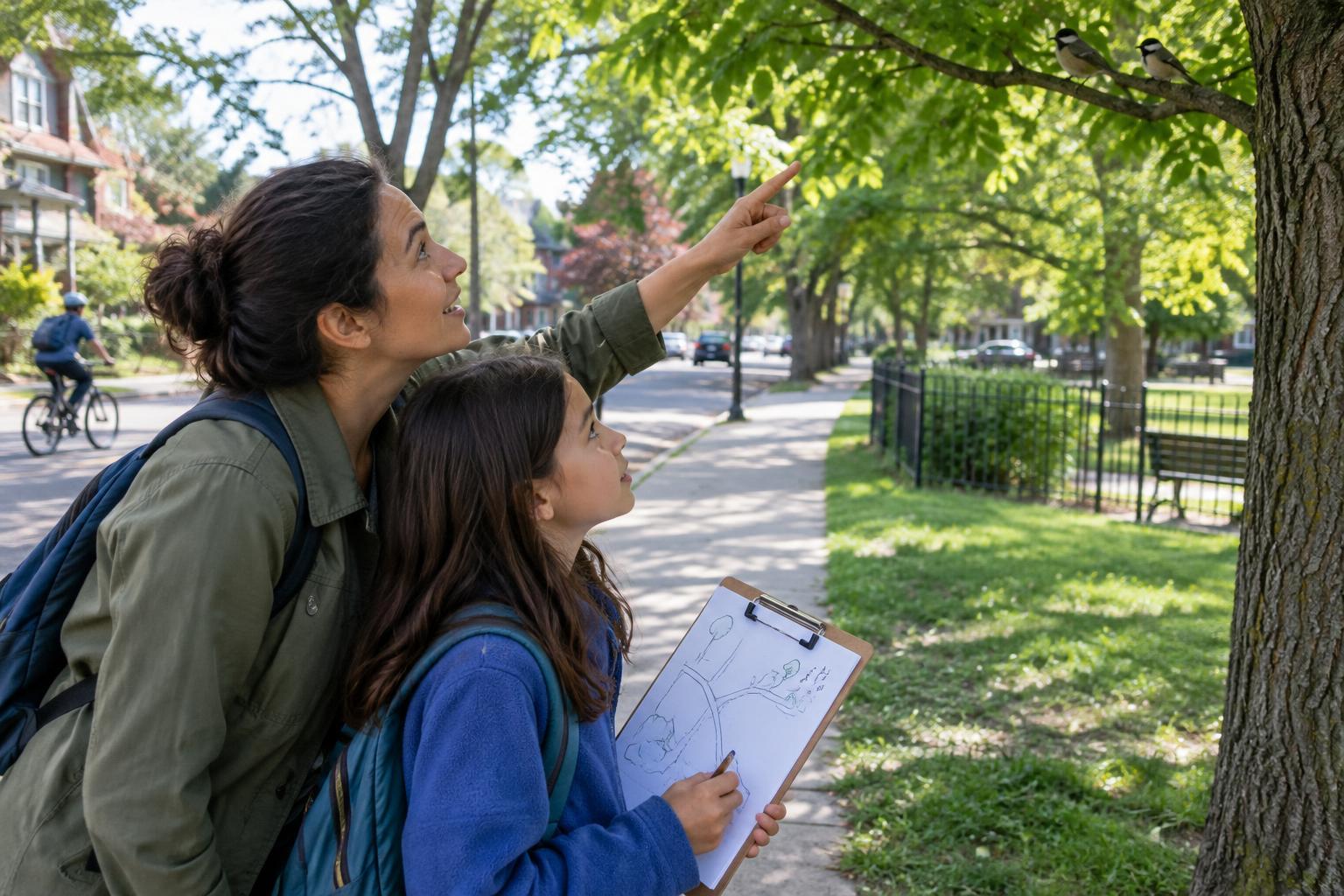
Another option is a “tree portrait.” Fold a piece of paper in half. On one side, draw the tree’s overall shape; on the other, sketch a close-up pattern from its bark or a fallen leaf. Accuracy matters less than including something you actually saw. A child who does not want to draw can dictate a description, trace a shadow with a finger on the pavement or invent a memorable nickname such as “the leaning corner tree.”
Notice the tree’s place on the street
Street trees share space with sidewalks, buildings, cars, people and other plants. Ask what the tree changes about that space. Where can you stand in its shade? Where do fallen leaves collect? Can you see a bird resting in its branches, or small plants growing nearby? If no animals are visible, that is an observation as well, not a failed search.
Look at the ground around the trunk without stepping into a planted bed. Is there open soil, grass, paving or a protective guard? You might notice that one tree has plenty of room around its base while another grows in a narrow opening. These details can lead to questions about how people make space for trees in a neighborhood. It is fine to leave those questions open and return to them later.
Come back and look again
A familiar tree can offer a new discovery on a repeat walk. Visit in different weather or at different times of year, and compare what you see with your first sketch or description. Leaves may change, shadows may fall in another place, and the ground beneath the branches may look different. Try asking, “What stayed the same?” alongside “What changed?”
Keep a simple record with the tree’s location, a drawing and a few words in your family’s own vocabulary. You can add a date to each visit so the observations stay in order. If someone later wants to learn the tree’s name, those notes may help guide the search. But naming can wait. The lasting skill is knowing how to pause, look closely and find something new on a street you thought you knew.