Set up a simple investigation
Will a spoon sink? What about a bottle cap or a ball of modeling clay? A sink-or-float activity begins with a question children can answer for themselves. The most interesting moment is often not getting a prediction right, but noticing when the water does something unexpected.
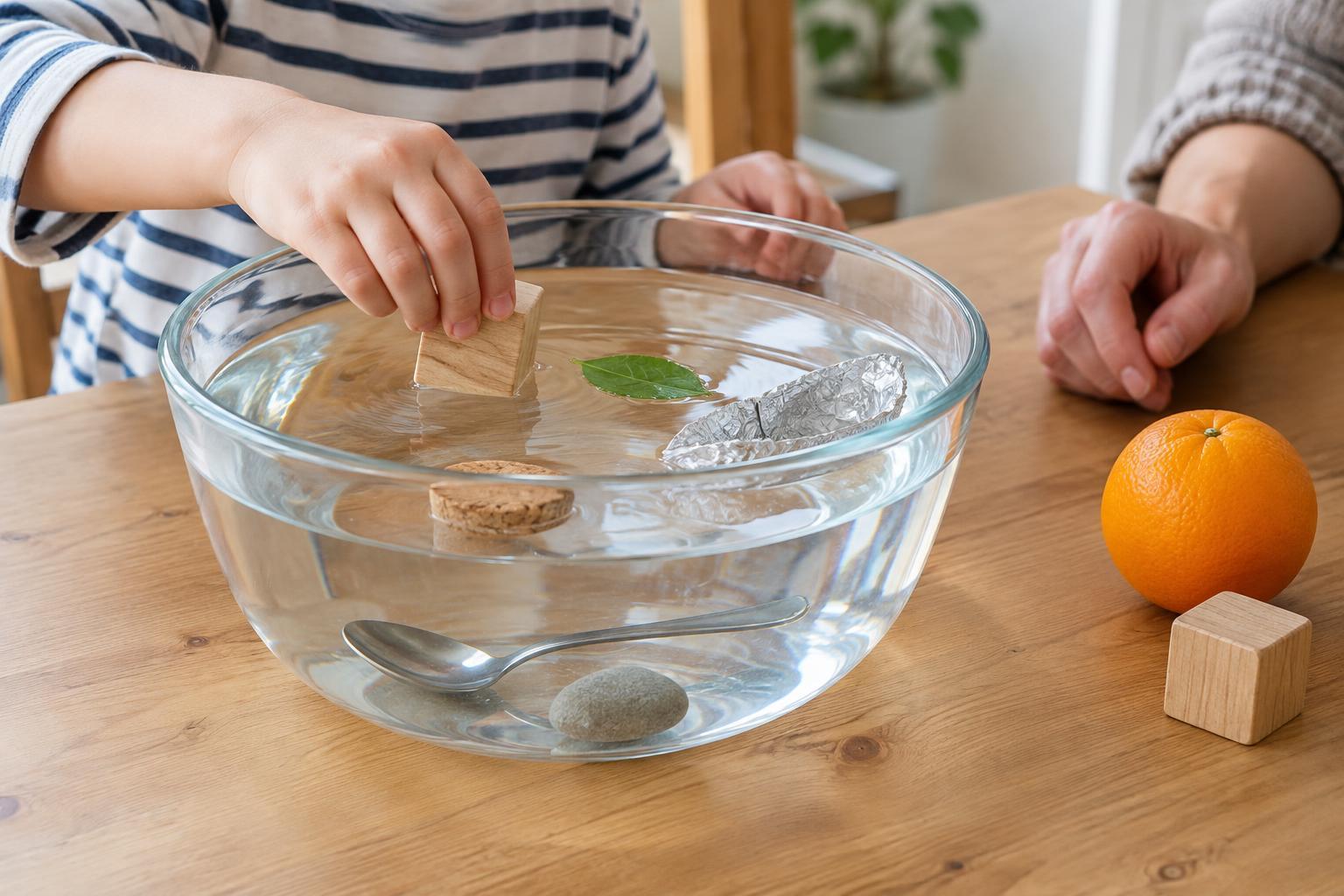
Fill a clear bowl or tub partway with water and place it on a towel. Gather a small collection of washable, water-safe objects, such as a metal spoon, a cork, a plastic lid, a pebble and a piece of modeling clay. Choose items large enough to handle safely, supervise young children around water and small objects, and keep electronics and anything that could be damaged by water away from the activity. Have a dry cloth and a place for wet objects ready before you begin.
Predict first, then test
Before putting an object in the water, ask, “Do you think it will sink or float? What makes you think so?” Accept every prediction as an idea to test. A child might expect a large object to sink because it looks heavy, or a smooth object to float because it resembles a boat. Those explanations give you something to revisit after the test.
Lower one object gently onto the water and let go. Watch for a few moments: does it stay at the surface, settle on the bottom or change position after it gets wet? Try to use the same bowl and amount of water throughout the first round. For results that are easier to compare, place objects on the water in a similar way rather than pushing some beneath the surface.
Make a simple record with four labels: object, prediction, result and what we noticed. A younger child can draw each object and mark the result with an arrow up or down. An older child might add details such as “floated at first, then sank.” Recording observations helps everyone separate what they expected from what they actually saw.
Look beyond heavy and light
Children often conclude that heavy things sink and light things float. Their tests may challenge that rule: a sizeable cork can float while a tiny pebble sinks. A useful explanation is that floating depends on how an object’s weight compares with the water it pushes aside. What an object is made of matters, but so can its shape and any air trapped inside it.
You can explore shape without introducing a new material. Roll a piece of modeling clay into a compact ball and test it. Then dry it, reshape the same piece into a broad, shallow bowl and test again. A clay bowl may float if it holds its shape and keeps water out; if it fills with water or collapses, it may sink. Either outcome is useful evidence. Ask, “What did we keep the same, and what did we change?”
Turn surprises into new questions
After the first round, invite each child to choose one result they want to investigate further. Could a floating plastic lid still float with a pebble resting on it? Does an empty, tightly closed plastic container behave differently from the same container filled with water? Test one change at a time when possible, so it is easier to discuss what may have affected the result.
If an object behaves differently on a second try, look closely before deciding the test failed. It might have trapped an air bubble, absorbed water or been set down differently. Try again and describe what changed. Science is not a contest to make every prediction correct; it is a way to use observations to improve an explanation.
Keep the conversation going
Once the objects are dry and put away, look for familiar examples during everyday activities. Why does an empty cup bob in bathwater but fill and tip when water spills into it? How might a wide boat carry objects that would sink on their own? Children do not need a perfect answer. Encourage them to connect what they noticed in the bowl with a new question they could test later.
End by asking each child to name one prediction, one observation and one idea they changed their mind about. That short conversation makes the activity more than a demonstration: it gives children practice asking questions, testing them and treating a surprise as the beginning of the next investigation.