Start with a question you can test
Where will the shadow of a stick point in an hour? Will it be longer, shorter or the same length? Asking for a prediction before making any marks turns shadow watching into an experiment. Children do not need to know the answer in advance. The interesting part is comparing what they expected with what they observe.
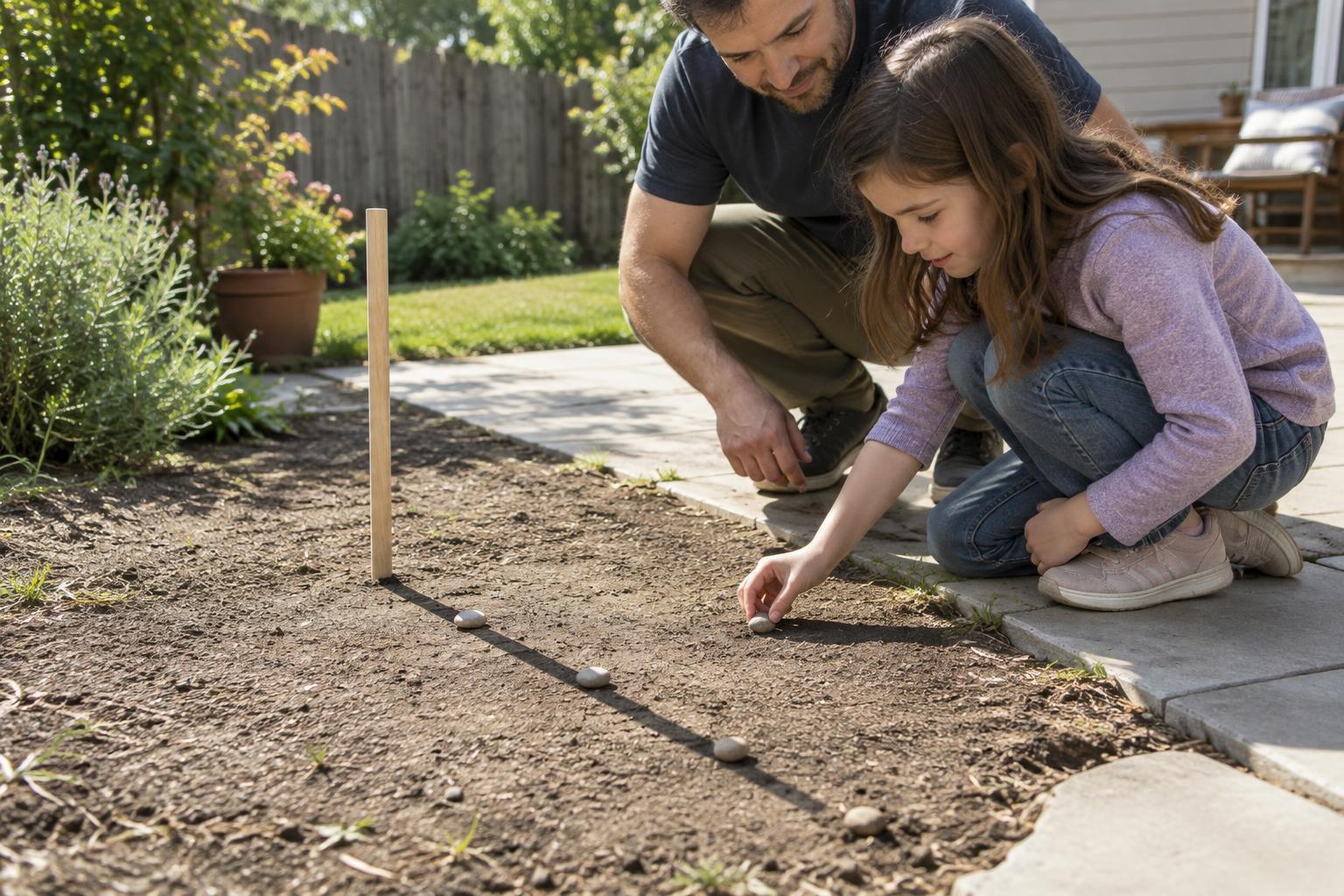
Choose a day when you can revisit one outdoor spot several times. An open, level area that receives direct sunlight for much of the day works best. You will need a straight stick or dowel, a way to keep it upright, small stones or pieces of chalk for marking, paper, a pencil and a clock. An adult can help secure the stick so it will not tip or become a tripping hazard. There is no need to look at the Sun: watch the ground instead.
Make a shadow record
Place the stick upright and leave it in exactly the same position throughout the activity. Mark the spot where its base meets the ground. At your first observation, mark the tip of its shadow and write down the time. If you are using chalk, label the mark directly on the ground. If you are using stones, make a quick sketch so you can match each stone to its time later.
Return about once an hour, or whenever your schedule allows. Each time, mark the new shadow tip and record the time. Try to make observations from morning into afternoon; a few spread-out measurements are more useful than many taken within a short period. If clouds hide the shadow, note that in your record and try again later. You can measure from the base of the stick to each tip mark, but estimating which marks are nearer and farther away also gives you something to compare.
For an extra challenge, draw a line from the base of the stick to each tip mark after the final observation. Label the lines in time order. Before you connect them, ask everyone to point out any pattern they notice. Has the shadow moved around the stick? Did its length change steadily, or did it grow shorter and then longer?
What is changing: the Sun or the Earth?
A shadow forms when an object blocks sunlight. It points generally away from the Sun, so its direction changes as the Sun appears to cross the sky. When the Sun appears low, a stick often casts a long shadow. When it appears higher, the same stick casts a shorter one. In a suitable spot, your shortest recorded shadow may be near the middle of the Sun’s daily path through the sky, though your observations may miss the exact moment.
The Sun’s daily motion is apparent motion: Earth rotates, carrying your observation spot around with it. That rotation changes the direction from which sunlight reaches the stick over the day. The shortest shadow will not necessarily occur at 12:00 on a clock. Clock time, location and the time of year all affect when the Sun reaches its highest point for your spot. For this activity, your own marks are more useful than trying to make them fit a particular hour.
Look closely at imperfect results
Real outdoor observations are rarely as neat as a diagram. A nearby tree might shade the stick at one time, while a slight slope could make one shadow look unusually long. The stick might lean, or a fuzzy shadow tip might be hard to mark precisely. Rather than treating these as mistakes to hide, ask which conditions might have affected the pattern.
One useful follow-up is to repeat the activity in a clearer location or with a more stable stick. Keep the stick’s height the same if you want to compare shadow lengths between two days. You can also place your marked sketch beside a second day’s sketch and look for similarities and differences without assuming the paths will match exactly. The Sun’s apparent path changes over the year, and your observation times and weather can change what you manage to record.
Turn the marks into new questions
Invite children to use the finished record to predict where the shadow would have fallen between two observations. They can add a different-colored mark for the prediction, then explain what evidence they used. Or ask them to imagine placing a taller stick at the same base point. Would its shadow point in a different direction, or mainly reach farther along a similar line? These questions encourage reasoning from the pattern rather than memorizing a rule.
To bring the investigation indoors, copy the marks onto paper and add a drawing of the stick at the center. Save the drawing as a record of one place on one day. Next time you notice a long building or playground shadow, you can ask the same simple questions: Where is the light coming from, which way does the shadow point, and what might change if you return later?