Start with a place you already know
A room does not need to look different to become a new world. The sofa can be a mountain range, the rug a lake and the space beneath a table a secret station. Making a map gives children a way to connect these ideas without requiring elaborate costumes or a finished craft project. It also gives them something they can change as the game grows.
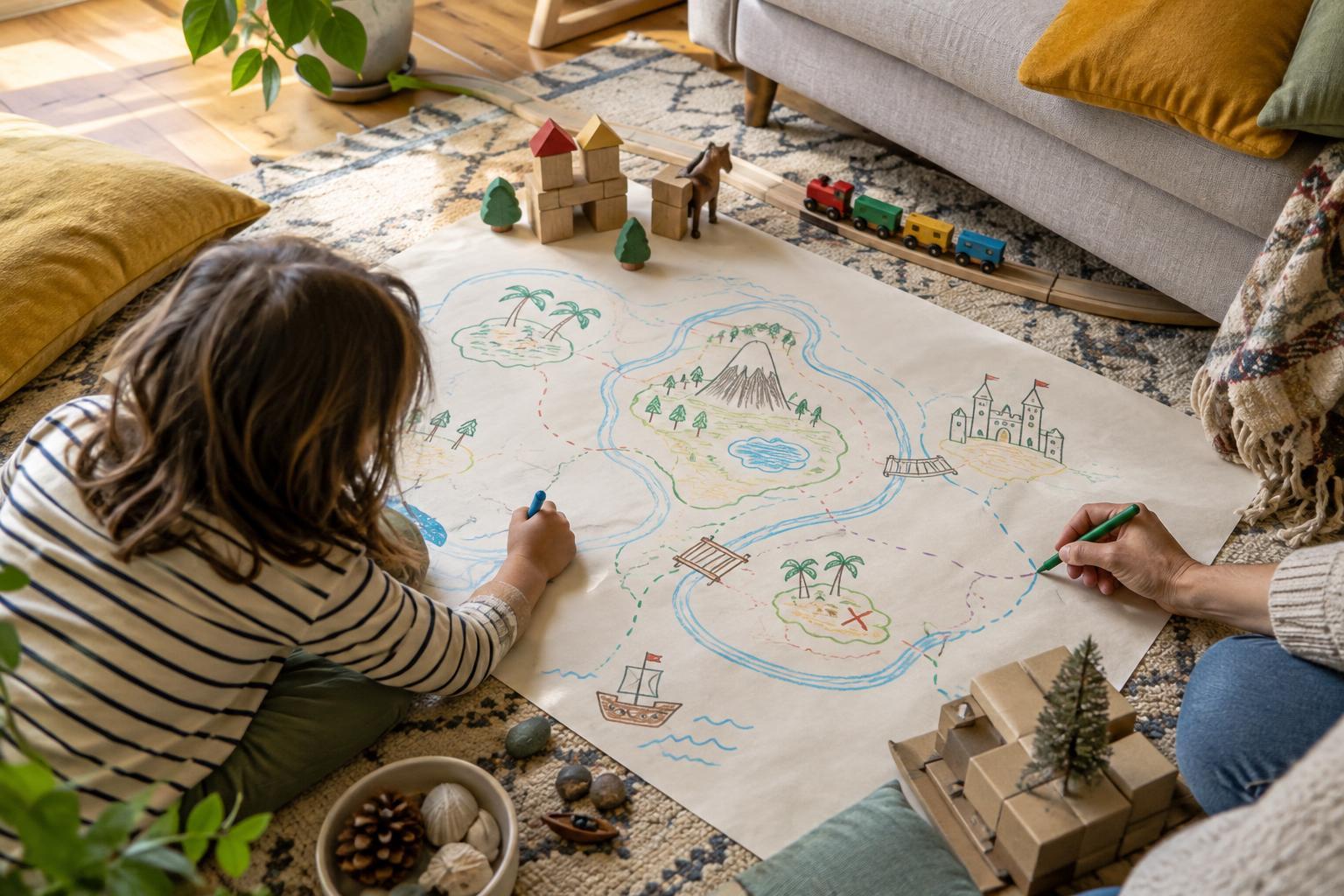
Choose one small area, such as a living room or bedroom, and gather a sheet of paper and a pencil. Invite your child to point out a few landmarks: a chair, a doorway, a shelf. Draw simple shapes to show where they are. The map does not need to be accurate or to scale. Its job is to help everyone remember where the adventure can happen.
Let the imaginary world take shape
Ask what this place might become. A chair could be a lookout tower, a cushion could mark a quiet campsite, or a clear patch of floor could be the town square. Write or draw each new name beside its real-world landmark. If a child prefers to tell you what to draw, that counts as making the map together.
Keep the first version small. Three destinations are enough to begin: somewhere to start, somewhere to visit and somewhere that invites a question. Who lives at the tower? What can travelers find at the campsite? A child may answer at once, leave the question open or change the whole setting. Treat those changes as part of the play rather than corrections to the map.
Add a journey instead of a script
Once the landmarks are named, invite someone to choose a route. They might travel from the doorway to the sofa mountain, then cross the rug lake to deliver an imaginary message. A finger can trace the journey on paper before anyone moves. Children who want active play can walk the route; others may prefer to move a small object across the map while narrating what happens.
Offer a gentle prompt when the journey slows: “What might we notice here?” or “Is there another way to get across?” These questions leave room for surprising answers. A folded blanket might become a bridge, but the travelers might also decide that the lake is friendly and can be crossed by singing. There is no need to make every stop a challenge or every adventure a story with an ending.
Make space for different kinds of players
Children do not have to participate in the same way. One may enjoy naming places while another likes drawing paths. A younger child might carry a toy from landmark to landmark; an older child might invent signs, symbols or a key for the map. Someone who wants to watch can be the person who announces what the travelers see next.
If several children have competing ideas, try giving each person a corner of the map to name or letting them add one landmark at a time. A shared map can hold a train station beside a dragon cave. Rather than asking which idea belongs, ask how the two places might connect. This keeps the world open without requiring everyone to agree on every detail.
Save the map, or let it disappear
At the end, you can leave the map where children will find it again, or put it away and start a different world another day. If you save it, a new route, visitor or landmark can extend the game. If you do not, invite everyone to recall one favorite place before the room becomes an ordinary room again.
The paper is not the prize. The useful part is the habit of looking at a familiar space and asking what else it could be. On another day, the same approach might turn a hallway into a river crossing or a tabletop into a miniature town. All you need is a place to begin and permission for the map to change.