Choose a place to pause
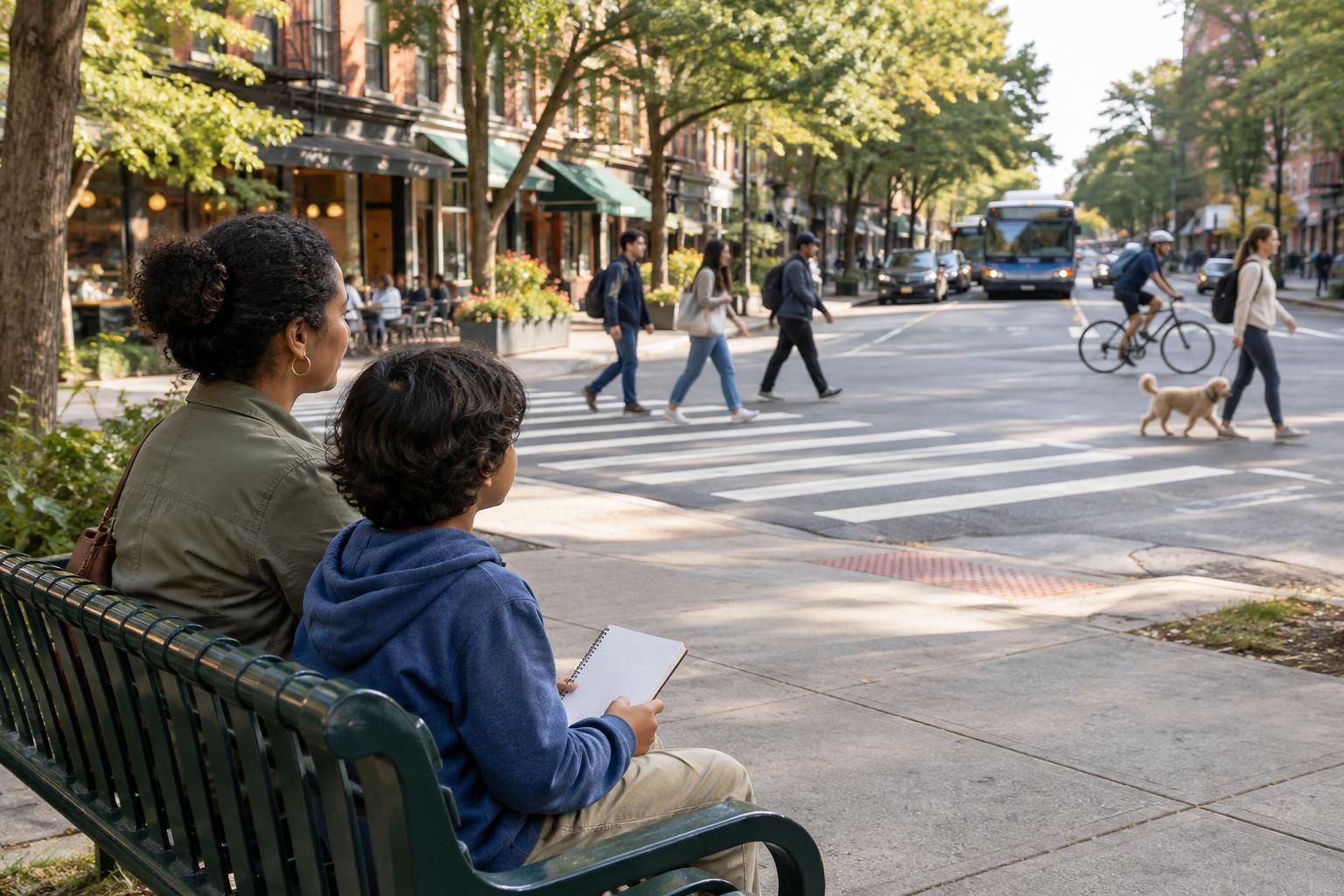
A busy street corner can be a tiny window into a neighborhood. People wait, vehicles turn, deliveries arrive, and sounds come and go. You do not need to travel along the street to explore it: the point of this activity is to stay in one place and notice what changes around you.
With a child, choose a public spot where you can stand or sit comfortably without blocking a sidewalk, doorway, ramp or crossing. Stay well back from the curb, and keep younger children close. A bench or a wide part of the sidewalk may work. If the corner feels too crowded or noisy, try a quieter one. There is no need to cross the street during the activity.
Bring paper and a pencil if you like, but you can do the whole activity by talking. Begin with a simple question: “What can we notice from here?” Give everyone a quiet minute to look and listen before sharing answers. That first pause often reveals things that are easy to miss while walking.
Make a small observation plan
Rather than trying to track everything at once, pick two or three categories. You might watch ways people move, places where people pause, or objects that help organize the corner, such as signs, curb ramps and traffic signals. Sounds make another category: footsteps, engines, birds or conversation may each come and go. Children can draw symbols instead of writing words.
Set a short observation period, such as five minutes. One person might make a tally each time a bicycle passes; another might sketch where people wait. Keep the task small enough that it remains playful. If counting becomes difficult, switch to descriptions: “Several people waited near the signal,” or “A delivery vehicle stopped, then left.”
Agree on what a mark means before you begin. Does a bicycle with someone walking beside it count as a bicycle passing, or as a person walking? There is no single required rule, but using the same rule throughout makes your notes easier to compare. This is a useful way to show that careful observation involves choices, not just sharp eyes.
Look for patterns, then look again
After the first round, compare what each person noticed. Did activity seem steady, or did it come in bursts? Where did people tend to wait? What happened when a signal changed? Ask children to point to something they saw before offering an explanation. “People stopped at this spot” is an observation; “They were all going to the same place” is a guess worth checking, not a fact.
Try a second short round with one new question. Perhaps you first watched movement and now want to listen for sounds. Or perhaps you noticed that one part of the corner stayed clear while another became crowded. A second look may support your first impression, complicate it or reveal something entirely different.
A simple corner map can help. Draw the sidewalks and crossing roughly, then add dots for places where people paused or arrows for directions of travel. It does not need to be to scale. The map turns a stream of events into something you can discuss together.
Notice how the corner helps people move
Street corners are designed for many kinds of movement, though they do not always serve everyone equally well. From your safe spot, look for features that may help people find their way: visible signs, crossing signals, painted markings, ramps, places to rest or space to pass. Ask, “Which features are easy to spot from here?” and “Is there anything we cannot tell without using the corner ourselves?”
Avoid making assumptions about individual people or why they behave as they do. Someone might pause for many reasons, and a brief observation cannot tell you their destination or needs. Focus instead on what the shared space makes visible. You can also leave names, identifying details and photographs of strangers out of your notes; drawings and general counts are enough for this activity.
Bring one question home
Before leaving, invite everyone to name one thing that surprised them and one question they still have. A child might wonder why people wait in different places or whether the corner sounds different when it is quieter. You do not have to settle every question on the spot. Wondering is part of the discovery.
At home, compare sketches or turn a tally into a simple picture chart. If you visit the same safe spot another time, you can repeat the same short observation and discuss what appears similar or different. One corner cannot explain an entire neighborhood, but watching it carefully offers a manageable way to practice noticing, describing and asking better questions about everyday places.