Start with a question, not a rule
A magnet can make an ordinary assortment of household objects feel surprising. A paper clip may jump toward it, while a piece of shiny aluminum foil stays put. Before explaining why, invite children to ask: Which of these objects will the magnet attract? Sorting predictions from test results makes this a small investigation rather than a demonstration with answers supplied in advance.
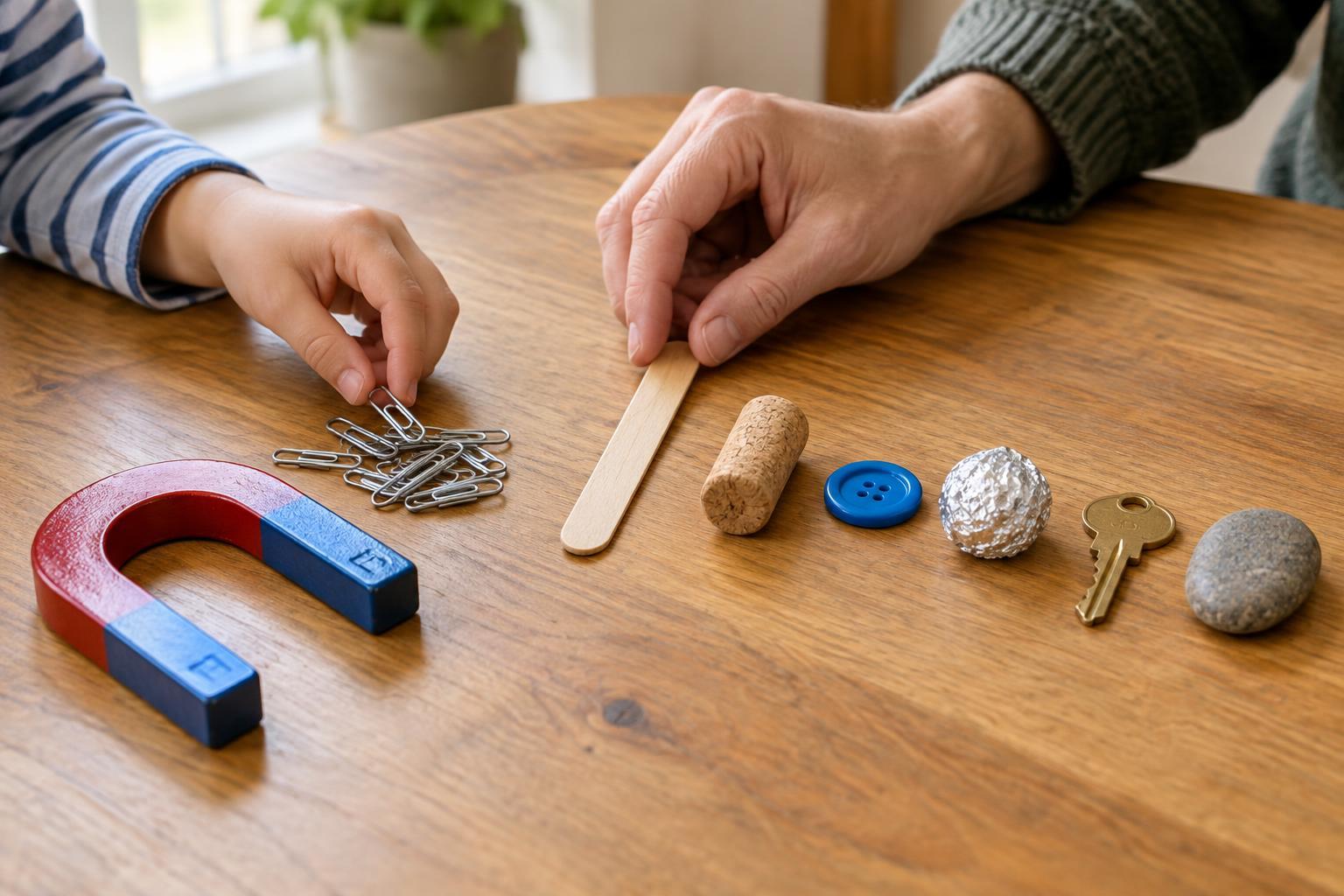
Choose one large, sturdy magnet that is easy for an adult to keep track of, along with a handful of clean, everyday objects. Possible choices include a steel paper clip, an iron or steel washer, a wooden block, a plastic lid, a rubber eraser, a piece of cardboard, and a ball of aluminum foil. Use items large enough that no one is likely to put them in their mouth. Place them on a table with two spaces labeled “I predict yes” and “I predict no.” If a material is uncertain, make a third space for “I’m not sure.”
Make safety part of the setup
Keep magnets and small metal objects away from children who may mouth or swallow them. Swallowed magnets can cause serious harm, so skip tiny or loose magnets altogether; an adult should supervise the activity and put all materials away afterward. Choose smooth, undamaged objects rather than sharp scraps, rusty pieces, or items with loose parts. Strong magnets can pinch fingers and may interfere with some electronic devices and medical devices, so a modest, sturdy magnet is a better choice for this activity.
There is no need to take apart appliances, toys, batteries, or electronics to find test materials. A short collection of familiar objects gives children plenty to compare. Count the objects before and after the investigation so cleanup is simple.
Predict, test, and sort
Ask each child to pick an object and explain their prediction. What do they notice about its color, weight, or texture? Record the guess with a drawing or a simple yes, no, or question mark. Then bring the magnet close to the object while it rests on the table. Does the object move toward the magnet, stick to it, or show no noticeable response? An adult can handle the magnet while younger children watch and describe what happens.
Move each tested object into a new group: “attracted” or “not attracted.” Keep this result separate from the prediction groups so surprises remain visible. Try bringing the magnet near the same spot twice if the result is unclear. For a larger object made of several parts, such as a binder clip, test different parts and describe which part responds. You can also place a thin sheet of paper or cardboard between the magnet and an attracted object to see whether the attraction is still noticeable. Avoid assuming the magnet must touch an object to affect it.
What the sorting results can tell you
Magnets strongly attract certain materials, especially iron and many kinds of steel. Steel often contains iron, which helps explain why a steel paper clip or washer may respond. Nickel and cobalt can also be attracted to magnets, although they may not be easy to identify among household objects. Materials such as wood, plastic, rubber, paper, and aluminum are not normally attracted to an ordinary magnet.
Looks alone can be misleading. A shiny object is not necessarily magnetic, and not every object described as metal will behave the same way. Some stainless steels are attracted to magnets and others are not. Coins and coated objects can contain different materials beneath their surfaces, so their behavior may vary. If a result seems unexpected, say “This object has a part the magnet attracts” rather than claiming to know its exact ingredients from a single test.
The investigation also tests an idea about categories: “metal” and “magnetic” do not mean the same thing. Invite children to compare two objects that look similar but behave differently, or two that look different but are both attracted. That comparison often leads to a better question than simply asking which pile is bigger.
Extend the investigation with better questions
Once the first round is finished, try a second round that changes just one feature of the test. Can the magnet attract a paper clip through one sheet of cardboard? What about two? Keep the same magnet and paper clip each time, and add layers without changing the distance in other ways. Children can draw what they observe instead of trying to measure an exact pulling strength.
Another extension is to make a “mystery object” prediction before showing the object. Describe its material if you know it, then ask whether that clue is enough to predict the result. At the end, revisit any guesses that changed. The goal is not a perfect score: it is noticing patterns, testing ideas fairly, and being willing to revise an explanation when an object behaves differently than expected.