Start with a question you can test
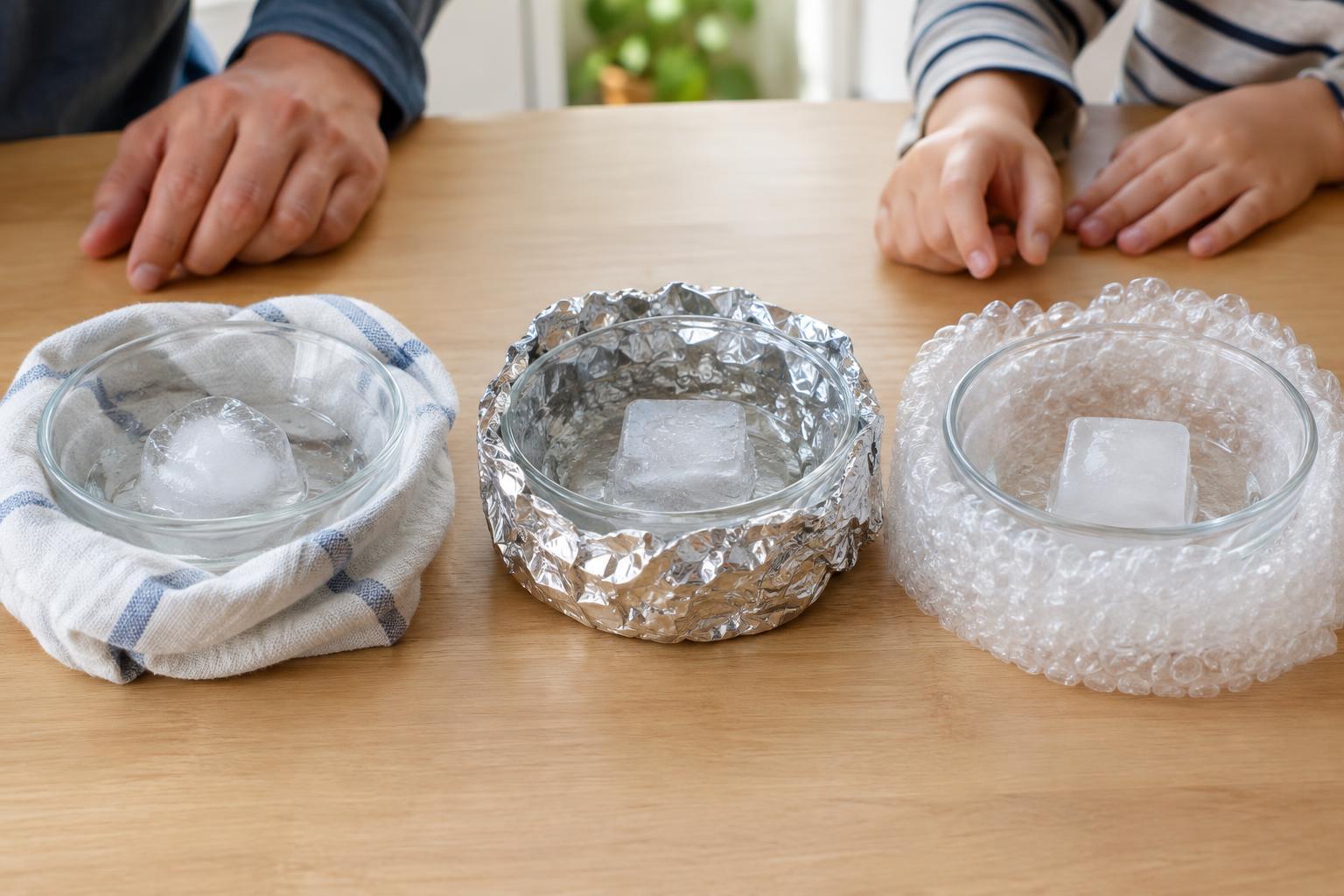
Will a cloth napkin, a sheet of paper or aluminum foil keep an ice cube frozen longest? It is tempting to guess based on how each material feels. A better approach is to test them side by side. This project uses ordinary household materials to explore insulation: slowing the movement of heat from warmer surroundings into something cold.
Gather several ice cubes from the same tray, small identical cups or bowls, a tray to catch drips, a timer and two or three wrapping materials. Paper, a thin dishcloth and foil make a manageable first set. Include an unwrapped cup as a comparison. Choose cups that let you place each cube in the same position, and use materials that are clean and safe to handle. If scissors are needed, an adult can help prepare the wraps.
Make the comparison fair
Place one similar-sized cube in each cup. Wrap the outside of each cup with one material, leaving the top arranged the same way for every cup. Do not wrap the cube itself: keeping the ice in cups makes it easier to check and contain the meltwater. Leave one cup unwrapped. Put all the cups together on the tray, away from direct sun, heaters and drafts, and start the timer.
Try to change only the wrapping material. Use the same cup type, roughly the same amount of wrap, and ice cubes taken out of the freezer at the same time. Decide in advance whether every cup will have an open top or whether each will have an identical loose cover. Otherwise, differences in airflow could affect the result. Equal layers do not always mean equal thickness, so describe what you used rather than assuming this is a perfect comparison.
Before checking the ice, invite everyone to predict what might happen and why. Record the predictions so they can be compared with the observations later. A prediction is not a promise to be right; it is an idea the test can help you examine.
Watch the melting, not just the clock
Check the cups at regular intervals, such as every five minutes. Look without holding a cup for long, since hands can warm it. Note whether each cube is mostly solid, partly melted or completely melted. A simple table with one row per cup and one column per check is enough. You can also sketch the cubes as they change shape.
Decide what “longest” means before you start. For this test, the winner might be the cup whose ice is the last to disappear. If two cubes melt between checks, you may not be able to tell which finished first. You can report a tie or repeat the test with more frequent checks. Keep the ice and meltwater out of drinks or food, since the materials and work surface may not be food-safe.
What can the results tell you?
Ice melts as heat moves into it from the room, the cup and the surface beneath it. A wrap can slow some of that heat transfer, but its effect depends on how it is used. Cloth may trap pockets of air; a loose paper wrap may also leave an air gap. Metal foil can reflect radiant heat in some arrangements, but when it touches a cup, it may behave differently from what someone expected. No single material is guaranteed to win every version of this test.
Compare each wrapped cup with the unwrapped one, then compare the wraps with one another. Ask whether the observations match the predictions. If results are close, small differences in cube size, wrapping or position could matter. Repeating the test can show whether the same pattern appears again. If the results change, that is useful information too.
Try one new question
A good experiment often leads to another. Next time, keep the material the same and change the number of layers. Or compare a snug wrap with a loose wrap that leaves an air gap. Change only one feature at a time so you can make sense of what happened. You could also test cups made from different materials, but treat that as a separate experiment.
Finish by having each person explain the result in their own words: Which setup held ice longest in this test, and what might have helped? The goal is not to find a universal best wrap. It is to practice making a prediction, arranging a fair comparison, noticing details and revising an idea when the ice tells a different story.